ZK/SEC Research notes from zkSecurity
All posts
educative · consensus · formal-verification

Beyond the Whitepaper: Where BFT Consensus Protocols Meet Reality

We just released a paper on the security of Byzantine Fault Tolerant (BFT) consensus protocols in collaboration with Matter Labs and Sigma Zero. The paper is a collection of lessons learned from analyzing the real-world security of various BFT consensus protocol implementations. You can find the paper on eprint.
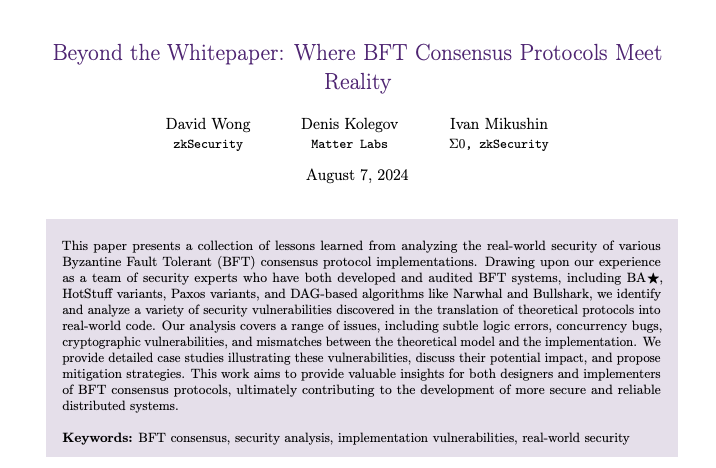
BFT consensus paper

Here is the abstract:

This paper presents a collection of lessons learned from analyzing the real-world security of various Byzantine Fault Tolerant (BFT) consensus protocol implementations. Drawing upon our experience as a team of security experts who have both developed and audited BFT systems, including BA$\bigstar$, HotStuff variants, Paxos variants, and DAG-based algorithms like Narwhal and Bullshark, we identify and analyze a variety of security vulnerabilities discovered in the translation of theoretical protocols into real-world code. Our analysis covers a range of issues, including subtle logic errors, concurrency bugs, cryptographic vulnerabilities, and mismatches between the theoretical model and the implementation. We provide detailed case studies illustrating these vulnerabilities, discuss their potential impact, and propose mitigation strategies. This work aims to provide valuable insights for both designers and implementers of BFT consensus protocols, ultimately contributing to the development of more secure and reliable distributed systems.

Keep reading
Recommended

BitVM: Unlocking Arbitrary Computation on Bitcoin Through Circuit Abstractions

We're diving into the world of Bitcoin's UTXO model and how recent advancements like BitVM can overcome its limitations, allowing for more complex computations without changing Bitcoin's core. This blog post explores cutting-edge techniques like covenants, statefulness, and circuit models, showing how they enable intricate logic on Bitcoin. We'll break down how these innovations make trustless cross-chain transactions possible, and highlight the potential of optimistic protocols to optimize the on-chain footprint. If you're curious about the future of Bitcoin's capabilities, this is the deep dive you need!

Katat Choi · March 03, 2025

Detecting boomerang values in zero-knowledge circuits using tag analysis

Ever wonder how zkApps ensure their execution is spot-on? This post digs into the idea of *boomerang values*, sneaky bugs that can crop up when zkApps mix in-circuit and out-of-circuit logic. We explore how these values disrupt your circuit's trustworthiness, especially when variables are reintegrated unverified. Plus, we share how tools like MIRAI's tag analysis can help spot these issues, making your zkApps more secure. Perfect for anyone into zero-knowledge applications or budding Rust enthusiasts looking for insights on taming complex bugs!

ZK/SEC · August 25, 2023

Optimistic One-Vote-Round Finality in BFT Consensus

An intuition-first walkthrough of why 33% BFT needs two voting rounds, how 20% designs get true one-round finality, and how an optimistic fast path can bridge the gap.

Suneal Gong · February 02, 2026
More to explore

noname: ZK app developers should be able to see down to the constraints

Zero-knowledge apps are evolving, and we've been diving into their two main forms: VM instructions and arithmetic circuits. Understanding the "assembly" layer is crucial for developers, especially when optimizing and ensuring security. We’ve played around with a new toy language called **noname**, blending Golang and Rust vibes to make zkApps more understandable. With **noname**, you get detailed insights about how your code translates into gates, offering a clearer picture of the underlying "assembly" and helping pinpoint compiler bugs. If you're curious about enhancing your low-level programming skills or peeking into circuit construction, check out our experiments and see if this inspires you to create better debugging tools!

David Wong · June 03, 2023

Partnership with StarkWare

We're teaming up with StarkWare to enhance Ethereum's scalability using an exciting tool called the EVM adapter. This innovative open-source project takes proofs from the Stone Prover and makes them verifiable on Ethereum, showcasing the power of Cairo bootloader programs for Layer 2 scaling. By diving into our collaboration, you'll get a glimpse of StarkNet's ability to streamline transactions efficiently and how our joint efforts are driving this tech forward. Plus, our Stark Book offers a deeper technical dive for the curious minds!

ZK/SEC · April 05, 2024

Lean4 formalization of "A Simplified Round-by-round Soundness Proof of FRI"

A Lean4 formalization of the paper "A Simplified Round-by-round Soundness Proof of FRI" by Albert Garreta, Nicolas Mohnblatt, and Benedikt Wagner, completed using Harmonic's Aristotle agent and Claude Code. Welcome to the strange world of machine-led formalization of cryptography.

Yoichi Hirai · January 26, 2026