ZK/SEC Research notes from zkSecurity

ZK/SEC Quarterly

Series 15 running series ← Current issue

Some subjects do not fit in one post. These are the threads we have run across several of them, newest first.

Variants of KZG 2 parts · April 2025 – July 2026 Series page →
Part 1

Variants of KZG: Part I, Univariate

In this blog post, we dive into the world of polynomial commitment schemes (PCS), which are crucial for constructing most practical SNARKs. We cover the basics of how PCS works, focusing on KZG10, known for its efficiency in proof size and verification time. You'll learn about the essential properties of binding and hiding and explore technical concepts like homomorphism, batching, and unconditionally hiding. We break down various methods to achieve these features, offering insight into how PCS maintains the security and privacy of polynomials in cryptographic systems. Get ready to understand these powerful concepts and their applications in modern cryptography!

Part 2

Variants of KZG: Part II, Multilinear Commitments with PST

In this blog post, we extend the ideas behind univariate KZG commitments to multilinear polynomials through the PST commitment scheme. We derive the multilinear quotient identity, explain how PST commits to and opens multilinear polynomials using a specialized multilinear setup and walk through its opening protocol. We conclude by examining the proof size, prover and verifier costs, and the limitations that motivate other multilinear polynomial commitment schemes.

zkao 3 parts · February 2026 – July 2026 Series page →
Part 1

zkao: Security That Compounds

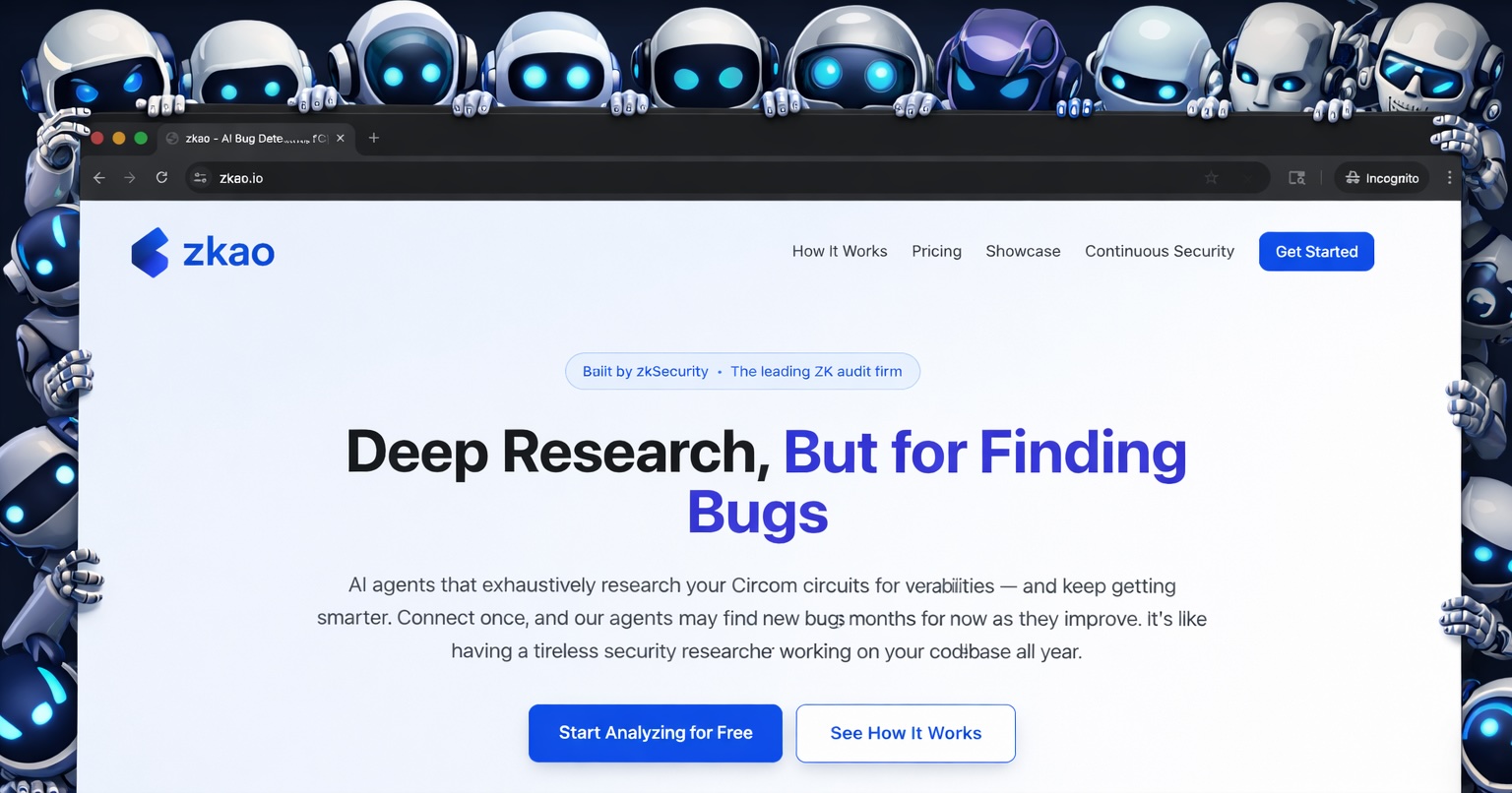
Today we're launching zkao, a product by zkSecurity that makes AI security research work the way fuzzing works: not as a one-shot event, but as something you run continuously until coverage compounds.

Part 2

Bringing Aleo and Leo into zkao

We recently brought Leo and Aleo support to zkao, our AI-powered bug-detection tool, and put it to work on a real engagement with HumanityLink. Getting an LLM to audit a young ecosystem like Aleo turned out to be less about the model and more about what we fed it - custom prompts or skills so it actually recognizes Aleo bug patterns, a harness called cheatVM that turns findings into real end-to-end proofs of concept instead of code that just looks right, and a clear threat model that significantly cut down our false positives.

Part 3

zkao 2.0 is here

zkao 2.0 is out: a complete redesign of our continuous security scanning tool, a new pay-as-you-go model that replaces subscriptions, and a long list of improvements across scanning, triaging, and reporting.

Proof is in the Pudding 9 of 10 parts · October 2024 – July 2026 Series page →
AI meets Cryptography 3 parts · July 2026 Series page →
Part 1

AI meets Cryptography 1: What AI Found in Cloudflare's CIRCL

We pointed our AI audit pipeline at Cloudflare's CIRCL experimental cryptography library and confirmed seven real bugs, from a critical float64 precision loss in threshold RSA to a complete access-control break in attribute-based encryption. All seven are now fixed upstream. This is the first post in a series on bugs our agents found across open source cryptography.

Part 2

AI meets Cryptography 2: What AI Found in OpenVM's zkVM

We turned zkao (our AI auditor) on OpenVM, a state-of-the-art zkVM, and it found a critical soundness bug: the pairing check accepted a prover-supplied witness without proper subfield checking, which lets a malicious prover forge any pairing equality. It is fixed in OpenVM 1.6.0 and tracked as CVE-2026-46669. This is the second post in our series on bugs our agents found across open source cryptography.

Part 3

AI meets Cryptography 3: What AI Found in Bron Labs's bron-crypto

We pointed our AI audit pipeline at bron-crypto, Bron Labs's Go library for MPC and threshold signatures, and confirmed four bugs. All of them are now fixed upstream. This is the third post in our series on bugs our agents found across open source cryptography.

mpcsec.org 2 parts · May 2026 – June 2026 Series page →
Part 1

Announcing mpcsec.org: What Goes Wrong When You Implement MPC

mpcsec.org is a new collaborative reference for common pitfalls in MPC implementations and the cryptographic primitives they rely on, built with contributors from zkSecurity, Trail of Bits, Partisia, and Zama. If you build, audit, or deploy threshold signatures, distributed key generation, or other MPC protocols, it's a starting point for the mistakes you don't want to repeat.

Clean 3 parts · March 2025 – June 2026 Series page →
Part 1

Introducing clean, a formal verification DSL for ZK circuits in Lean4

We're diving into our new project called **clean**, aimed at creating an embedded DSL and formal verification framework for Zero Knowledge (ZK) circuits using Lean4. Imagine being able to not only define ZK circuits but also formally prove their correctness. Sounds like a game-changer, right? We'll walk you through our process of building a robust library of reusable, verified circuit gadgets, focusing on the importance of soundness and completeness. Plus, you'll get a peek at some cool examples like 8-bit addition and how we're tackling ZKVM design with techniques borrowed from Fibonacci sequences. It's exciting stuff, and if you're curious about how we're paving the way for bug-free ZK circuits, this is a read you won't want to miss!

Part 2

Verifying Poseidon in Clean: Why the Last 'sorry' Is About Primality

We walk through a Lean 4 proof of correctness for a Clean model of circomlib's optimized Poseidon hash circuit at arity 1. The theorem says the modeled constraints are sound and complete with respect to the optimized Poseidon spec. After weeks of work, the only remaining `sorry` was a primality proof for the BN254 scalar field: a 254-bit number that no proof assistant can decide by trial division. Closing it requires a Pratt certificate, a recursive proof structure based on a theorem Lucas published in 1876.

Part 3

Clean: From Verified Circuits to Verified zkVMs

Clean, our circuit DSL, is growing toward verification of complex multi-AIR ensembles. We introduce channels as a way to model lookups, permutation arguments, and zkVM cross-table interactions, then explain how local gadget proofs can compose into global soundness theorems. Watch our talk from ZKProof 8 or read the post.

Sum-Check as an Algebraic Tensor Reduction 3 parts · April 2026 – May 2026 Series page →
Part 1

Sum-Check as an Algebraic Tensor Reduction: Part I

This post introduces algebraic tensor reductions as a unifying framework for understanding recursive proof protocols, using sum-check as the main motivating example. It walks through one recursive step of sum-check, showing how the prover sends a univariate summary, the verifier checks sum consistency, and the original claim is reduced to a smaller claim with one fewer variable. A small bivariate example illustrates how this “peel off one variable, check, then fold with randomness” pattern works concretely. The post sets up the rest of the series, which will introduce the tensor language needed to recover classical sum-check as an algebraic tensor reduction.

Part 2

Sum-Check as an Algebraic Tensor Reduction: Part II

In this part of our series, we start introducing the algebraic language needed to formalize sum-check as a tensor reduction. We start with the basics of rings and modules. Rings generalize fields by dropping the requirement that every non-zero element has a multiplicative inverse. Modules then generalize vector spaces by allowing scalars to come from a ring instead of a field. In this post, we’ll use plenty of examples to make these ideas concrete and build intuition along the way.

Part 3

Sum-Check as an Algebraic Tensor Reduction: Part III

This post is all about the maps that let us move between modules without breaking their structure. We’ll see when a map is truly “linear,” when two modules are (secretly) the same, and why two-input maps deserve special attention. Along the way, (bi-)linear maps and isomorphisms become less like abstract definitions and more like tools we can actually use. By the end, we’ll have all the tooling we need to tackle abstract tensor products head-on.

Jolt 4 parts · September 2024 – May 2026 Series page →
Part 1

A challenge on the Jolt zkVM

Last weekend, we had a blast crafting challenges for a CTF event at the MOCA Italian hacker camp. One cryptography challenge, "2+2=5," involved the Jolt zkVM and a RISC-V program. In this post, we share the ins and outs of the challenge, the clever use of a modified Jolt library, and how we managed to prove an invalid execution without triggering verification alarms. Get ready to dive into the world of Jolt and pick up some nifty insights on exploiting cryptographic systems like a true hacker.

Part 2

Improving the Security of the Jolt zkVM

We recently explored a16z’s Jolt zkVM to bolster its security, discovering significant bugs in the process. Our findings revealed vulnerabilities that could allow malicious provers to forge proofs, highlighting the crucial role of manual reviews in catching these issues. Jolt, with its unique approach using the Lasso lookup technique, aims to improve prover efficiency and system scalability. With these bugs now fixed, this work underscores the importance of thorough audits in ensuring the reliability of advanced zkVM technology. Stay tuned as we continue to delve into zkVM security insights.

Part 3

A Technical Dive into Jolt: The RISC-V zkVM

In our latest post, we take you inside the workings of Jolt, a zero-knowledge virtual machine for the RISC-V architecture. This post breaks down the three main components that prove execution correctness: instruction lookup, offline memory checking, and the Rank-1 Constraint System (R1CS). By exploring these elements, you'll get a grasp on how Jolt ensures VM execution is accurate and reliable, using innovative methods like Lasso lookup arguments and the Spartan protocol. Join us as we unravel this cutting-edge zkVM, which not only promises simplicity but also the potential for exciting advancements.

Part 4

Breaking Jolt’s Verifier with an Unbound Uni-Skip Claim

We found a critical soundness bug in Jolt’s transparent verifier that allowed a forged proof for an invalid execution to verify. The issue was fixed quickly after disclosure, and the full PoC and write-up are available in the linked repository.

Lattice SNARKs 3 parts · June 2025 – April 2026 Series page →
Part 1

Proofs On A Leash: Post-Quantum Lattice SNARK With Greyhound

In this engaging blog post, we dive into the future of cryptography by exploring how lattice-based proof systems could fend off the quantum threat. We break down Greyhound, a promising lattice-based solution, explaining its transparent nature, efficient construction, and adaptability with today's systems. Along the way, you'll get a glimpse of key concepts like lattices, Ajtai commitments, and how Greyhound cleverly ensures security and efficiency. Whether you’re curious about the cutting-edge of cryptographic research or just want to understand the basics of quantum-resistant solutions, this post offers both depth and clarity.

Part 2

Playing with LaBRADOR: Building Compact Lattice-based Proofs with Recursion

In this post, we explore LaBRADOR, a transparent, lattice-based proof system that achieves sublinear proof sizes through recursion. Built on the Module-SIS assumption, LaBRADOR lets a prover efficiently demonstrate knowledge of short vectors satisfying dot product constraints, general enough to express R1CS. The protocol’s key ideas include amortized openings, outer commitments, and a strategy to shrink the witness after each round of recursion. Together, these techniques make LaBRADOR a powerful, scalable framework for post-quantum zero-knowledge proofs.

Part 3

Soundness Failures in LaBRADOR Implementations from NTT -Friendly Rings

Post-quantum cryptography is making its way into production libraries, and correct implementation is far from trivial. We reviewed several LaBRADOR implementations on GitHub and found three of them broken, with soundness collapsing as far as a single bit, because of parameter choices that look perfectly reasonable in many lattice-based protocols; a power-of-2 modulus, a composite modulus, or NTT-friendly rings for efficient ring multiplication. The post goes through how each of those choices undermines the protocol's soundness argument, and why NTT-friendliness, of all things, turns out to be the wrong instinct if not handled carefully.

Circle STARKs 4 parts · June 2024 – November 2025 Series page →
Part 1

Circle STARKs: Part I, Mersenne

Discover the intriguing world of Circle STARKs and how they can supercharge zero-knowledge proofs. This blog post sets the stage for a fascinating series about utilizing Mersenne prime fields to achieve lightning-fast arithmetic operations in STARK systems. You'll explore recent breakthroughs that make these fields more practical despite their previous limitations, and you'll get a sneak peek at what’s to come, including delving into group structures and implementing circle FFTs. If you're keen on cryptography and zero-knowledge proofs, this series will unveil how modern advancements are pushing the boundaries of what's possible.

Part 2

Circle STARKs: Part II, Circles

In this blog post, we dive into the fascinating world of Circle STARKs, exploring the algebra of complex numbers and how they can be extended to any field. We revisit the concept of the unit circle and its unique group structure, which allows for cool operations like squaring and doubling angles. You'll discover how these ideas apply to finite fields, creating intriguing structures like the twin-coset and standard position coset. The post leads us to understand vanishing polynomials, crucial in STARKs, and sets the stage for exploring the circle FFT in upcoming discussions. Perfect for anyone curious about cutting-edge cryptographic techniques!

Part 3

Circle STARKs: Part III, Circle FFT

In this blog post, we explore how to efficiently implement polynomial operations using Circle FFT in the context of STARKs, drawing parallels with the Cooley-Tukey FFT. We discuss how the Circle FFT handles bivariate polynomials over the circle group, replacing traditional multiplicative subgroups with twin-cosets. You'll discover the nuanced process of decomposing and recomposing polynomials using projection and squaring maps, leading to efficient computations. We also address the gap between the polynomial degree space and the space spanned by Circle FFT. This is a fascinating dive into the heart of polynomial computations in cryptography.

Part 4

Circle STARKs: Part IV, Arithmetizing Circles

In this final part of our series on Circle STARKs, we tie together concepts from Mersenne prime fields, circle curves and bivariate polynomials to showcase a comprehensive Circle STARK protocol. We detail the process of arithmetization over the circle curve, introducing Circle FRI as a low-degree test and walk through the complete Circle STARK construction. Readers will explore how trace commitments, constraint batching and low-degree proofs combine for efficient verifiable computation, delving into the nuances of proof validity and security analysis.

Bulletproofs 3 parts · October 2025 – November 2025 Series page →
Part 1

Breaking Down Bulletproofs: No Pairings, No Trusted Setup

Learn how Bulletproofs enables efficient zero-knowledge proofs without trusted setups by computing inner products in a verifiable way. This post breaks down the core folding technique that reduces large vectors to single elements through recursive compression, making proofs both compact and fast to verify. Used in Monero, Mina's Kimchi, and Zcash's Halo 2, Bulletproofs is a practical alternative to pairing-based schemes.

Part 2

Unfolding the Bulletproofs Magic: A SageMath Deep Dive

In this post, we dive deep into the Inner Product Argument (IPA), the mathematical core of Bulletproofs. Starting from simple vector folding, we build up to a full zero-knowledge proof with Pedersen commitments, explore how the mysterious `L` and `R` terms appear, and finish with smart verifier optimizations. All illustrated with clear, runnable SageMath code.

Part 3

Stay in Range: Deeper Into Bulletproofs

This article breaks down how Bulletproofs enable range proofs: proofs that a hidden value lies within a range without revealing it. Starting from bit decomposition, it shows how to express and combine constraints into a single inner product, then make the proof zero-knowledge with blinding polynomials and commitments. By the end, you’ll understand how systems like Monero’s confidential transactions prove valid amounts while keeping values private.

Common Circom Pitfalls 2 parts · June 2025 – November 2025 Series page →
Part 1

Common Circom Pitfalls and How to Dodge Them, Part 1

Programming in Circom comes with its fair share of challenges. After reviewing numerous Circom codebases, we’ve identified certain anti-patterns that occur frequently. In this series, we’ll provide a comprehensive overview of these issues to help you avoid the most common pitfalls. Of course, this won’t be a complete list of every mistake possible (Circom has plenty of ways to trip you up). But the footguns we’ll cover are the ones that tend to catch developers off guard the most.

Part 2

Common Circom Pitfalls and How to Dodge Them, Part 2

This post is the second part of our series on Circom pitfalls. While part 1 covered issues with assertions, hints, and aliasing, this one explores unsafe component usage and the subtle fact that Circom’s comparison operators work over signed integers.

zkbugs 2 parts · August 2024 – February 2025 Series page →
Part 1

Reproducing and Exploiting ZK Circuit Vulnerabilities

Check out our latest blog post where we dive into the world of Zero-Knowledge Proof (ZKP) vulnerabilities, sharing our insights from replicating known ZK circuit weaknesses. We’ve launched a GitHub repo with detailed scripts to help you understand, reproduce, and learn from these vulnerabilities. Discover how this hands-on approach aids in grasping attack vectors, testing fixes, and enriching educational resources. Whether you're a researcher or a developer, this post is packed with info to enhance your knowledge and skills in ZKP security. Plus, find out how you can contribute to expanding this invaluable resource!

Part 2

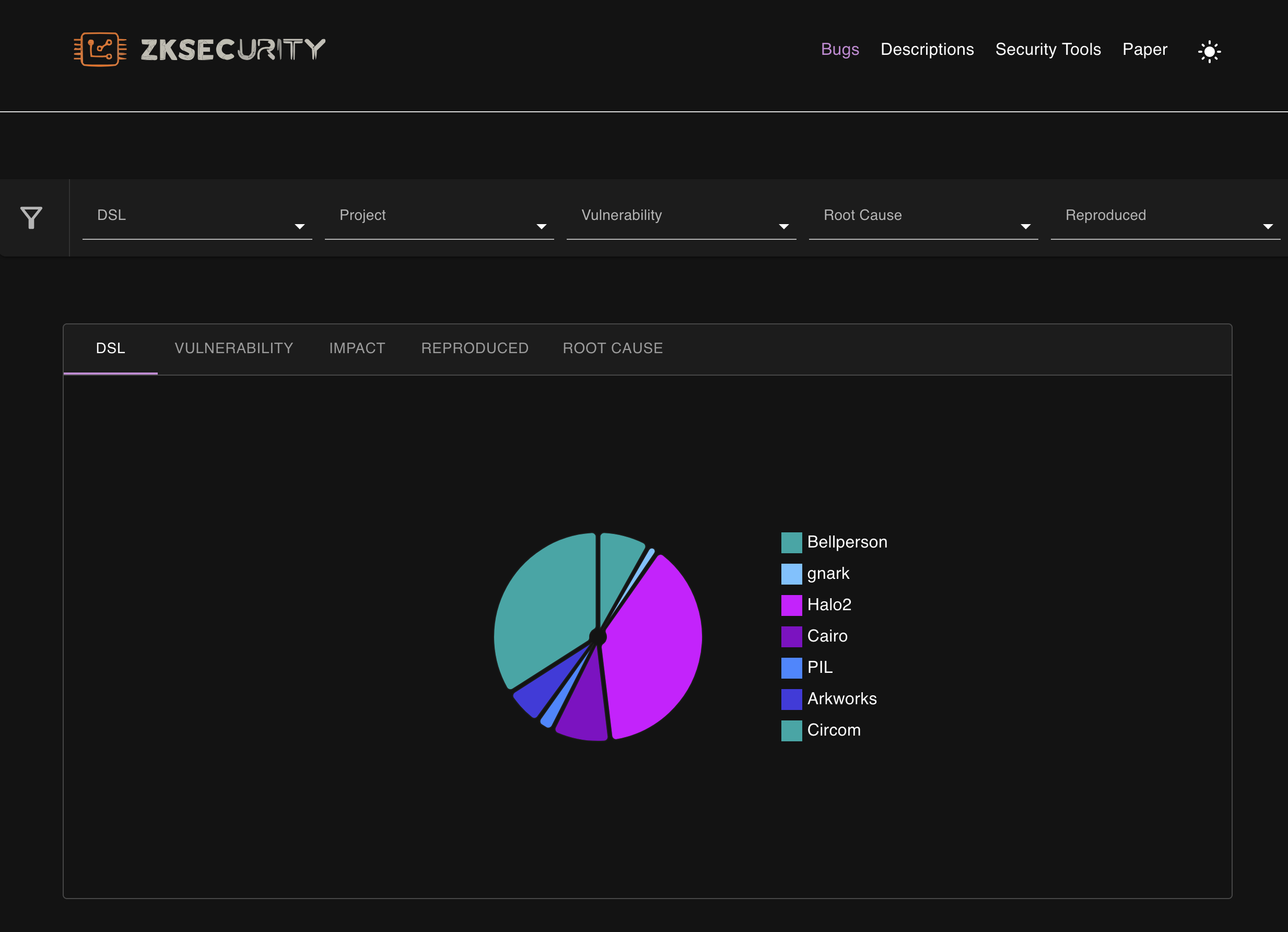
Introducing bugs.zksecurity.xyz a knowledge base for ZK bugs

We're thrilled to introduce our new site, [bugs.zksecurity.xyz](https://bugs.zksecurity.xyz/), a hub for exploring past vulnerabilities in ZK circuits. Dive into our growing catalog of documented bugs and learn how we've reproduced some with comprehensive scripts. Discover evaluations of prominent security tools like Circomspect and Picus, and see where they shine or stumble. We're calling on the community to join us in expanding this invaluable resource, whether by adding bugs, reproducing them, or improving our platform. Let's collaborate to elevate ZK security together!

noname 4 parts · June 2023 – November 2024 Series page →
Part 1

noname: ZK app developers should be able to see down to the constraints

Zero-knowledge apps are evolving, and we've been diving into their two main forms: VM instructions and arithmetic circuits. Understanding the "assembly" layer is crucial for developers, especially when optimizing and ensuring security. We’ve played around with a new toy language called **noname**, blending Golang and Rust vibes to make zkApps more understandable. With **noname**, you get detailed insights about how your code translates into gates, offering a clearer picture of the underlying "assembly" and helping pinpoint compiler bugs. If you're curious about enhancing your low-level programming skills or peeking into circuit construction, check out our experiments and see if this inspires you to create better debugging tools!

Part 2

noname meets Ethereum: Integration with SnarkJS

We're excited to share that our programming language, noname, now supports R1CS, making it easier to write zero-knowledge (ZK) circuits and deploy them on Ethereum using SnarkJS. This update introduces an alternative to the common Circom language, with a simple and intuitive syntax inspired by Rust and Golang. In this post, we illustrate how to deploy a noname-based Sudoku circuit on Ethereum, demonstrating core benefits like proving a solution's correctness without revealing it. Dive in to explore how noname could potentially unify the fragmented zkSNARK ecosystem and simplify your circuit writing process!

Part 3

noname 2.0: Unlocking Numeric Generics, Folding Schemes, and a Playground

We're excited to introduce the preview of noname 2.0, packed with features that make developing advanced ZK circuits easier than ever. This update includes flexible generic-sized arrays, seamless integration with folding schemes for IVC, and an interactive online playground to test and share code. We've also optimized R1CS constraint generation to boost performance. Plus, there are numerous community-driven enhancements and bug fixes that make the language more robust and user-friendly. Dive in to explore the specifics of our journey, learn from the contributions of our vibrant open-source community, and see how noname is evolving into a more versatile tool for developers.

Part 4

noname 3.0: Native Hints, Standard Library, Compiler Visualizer, And More!

We're super excited to introduce noname 3.0, our zk programming language inspired by Rust and Golang, now achieving full feature parity with Circom. This update brings native hints, a standard library, debugging features, and a lot more to enhance developer experience. Dive into how hint functions work with an 'unsafe' keyword to balance innovation and security, explore our new stdlib modules, and see how the compiler pipeline visualizer can help you understand the compiling process. Plus, check out our next steps and how you can contribute to shaping noname's future.

ZPrize 2 parts · August 2023 – May 2024 Series page →
Part 1

zkSecurity partners with ZPrize to make you win hundreds of thousands of dollars!

We're gearing up for this year's ZPrize competition, where we'll be hosting the High Throughput Signature Verification category. This challenge is all about creating the most efficient signature verification circuit using Aleo's Varuna proof system. Participants will work with ECDSA on the Bitcoin and Ethereum curve and the Ethereum hash function, keccak256. It's a great chance to dive into some of the hottest problems in arithmetic circuits and optimize cryptographic algorithms. If you're curious about pushing the boundaries in ZK, join us and share your feedback on our prize specification through our Discord channel.

Part 2

ZPrize Came To An End! Who And How Did They Win $500,000?

In an exciting collaboration with ZPrize, we embarked on a journey to discover the fastest proofs for ECDSA signatures, ultimately crowning two standout approaches as winners. The blog post delves into the innovative solutions that captured the $500,000 prize by pushing the boundaries of zero-knowledge proofs. The story offers a fascinating glimpse into how these cutting-edge techniques might pave the way for privacy-focused applications. Curious to know which teams came out on top and how they did it? Dive in to explore the thrilling results and what's next in the ZK space!