
ZK/SEC Research notes from zkSecurity
All posts
announcement · tools · security

You like Circom but you find it confusing? Introducing Circomscribe

circomscribe

If you've been working in the field of zero-knowledge in the last few years you must have heard of Circom, a tool to write zero-knowledge applications in the form of circuits. Many projects have used Circom, that is the least one could say, as perhaps most ZK projects that have been built as smart contracts directly on Ethereum have been built using Circom; the most infamous project probably being TornadoCash.

While Circom has been great for developers wishing to explore usecases brought by zero-knowledge proofs, it is an extremely low-level tool, and it has proven to be quite hard to use correctly. One could almost say that if you don't understand how circuits (or proof systems) work at a low-level, you're going to run into trouble.
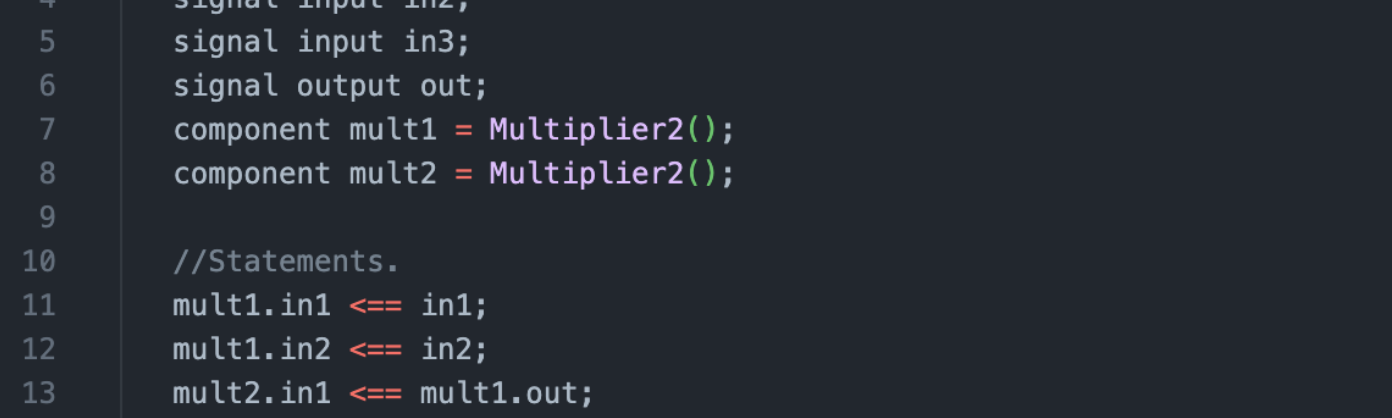
circom program example

As part of auditing ZK applications, zkSecurity has gone through its fair share of Circom circuits audits, and has realized that one of the biggest source of bugs (besides human error) is that developers have little idea of how their code eventually gets transcribed into "constraints" by the Circom compiler. In a way, it is similar to not being able to see the assembly your code compiles to, and as such making wrong assumptions sometimes.

While many more user-friendly and secure zk platforms and tools are making their way in (including our own in-house noname), the ecosystem of today is still very much based on Circom. So what can we do about this?

I say: let's improve everyone's understanding of how their Circom code gets compiled down to constraints! The more we educate developers, the less bugs they will write. To achieve this, we'd like to introduce Circomscribe.

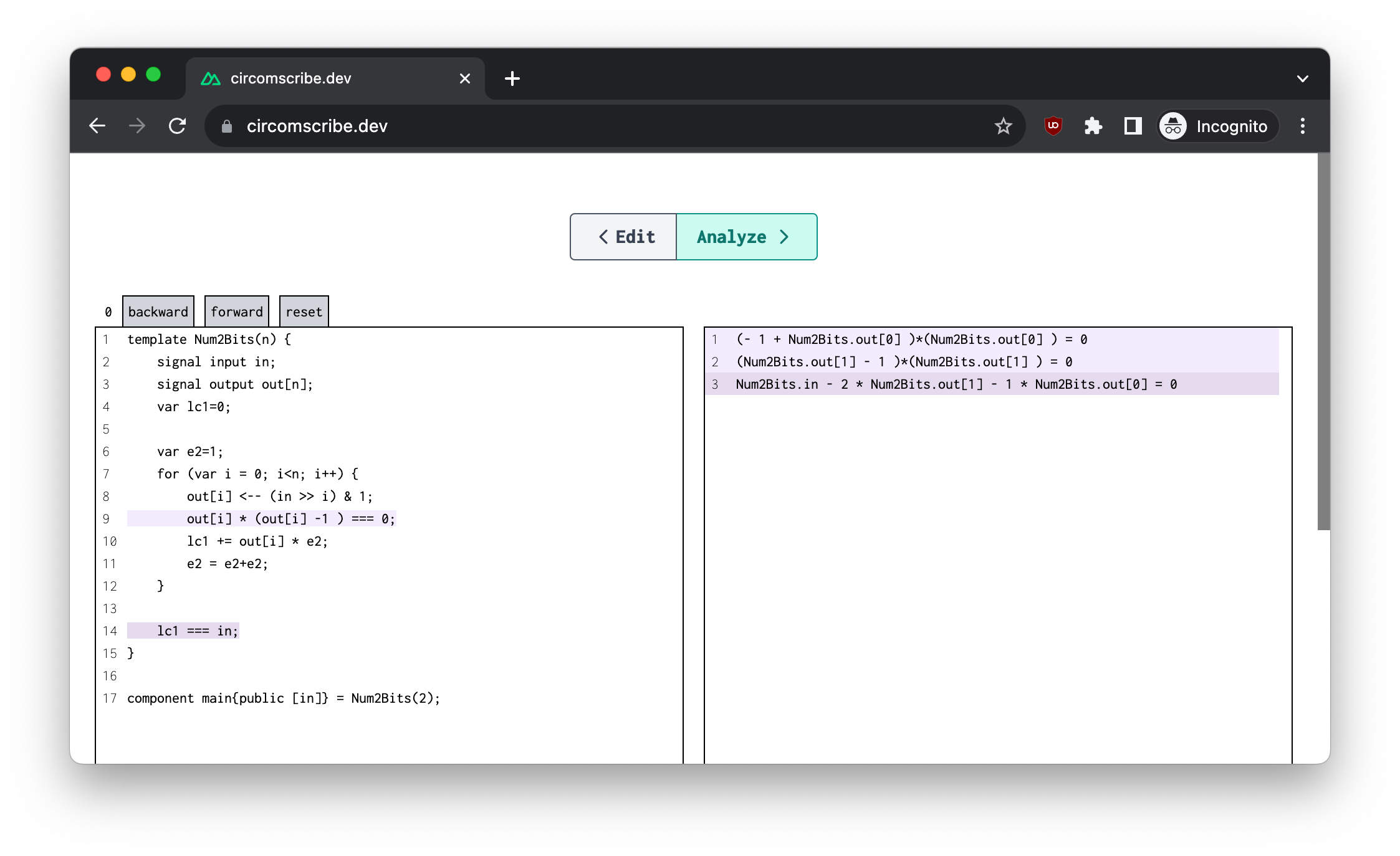
Circomscribe is a tool that shows you what Circom does with your code. Simple as that. Paste your complete circuit in the tool, press a button, and quickly get an idea of what lines of code produce what constraints (if any).

For example, here's the analysis of the Num2Bits template (which converts a value to a list of bits) taken directly from circomlib, the standard library of Circom:
Circomscribe

As you can see, only the lines of code that are highlighted on the left produce constraints. These constraints are "pure" constraints, which is what the compiler produces before actually unrolling the circuit (for example, if a template is used several times) and before any optimizations are performed. So in a sense, this is purely useful to understand the first pass of the compiler, but not useful to see what the actual compiled circuit looks like.

Underneath, Circomscribe is essentially a modified version of the Circom compiler to run in WASM and emit information in a JSON format when compiling. As of now, the Circomscribe tool provides simple features that we hope will be useful to developers and other security engineers. We hope to add more features in the future. If you have any ideas, please let us know!

Keep reading
Latest

Optimizing Cryptography with AI

Many of us are using AI to generate code. Vibe coding cryptography is especially sensitive - you have to uphold strict mathematical correctness. This can lead to wrong security guarantees and soundness bugs. We will discuss what are some patterns to do it well.

Kobi Gurkan · August 11, 2026

Introducing zkvmBlast: Differential Fuzzing for Ethereum's zkVMs

zkVMs are moving to the center of Ethereum's roadmap, which means a bug in a zkVM is turning into a bug in Ethereum itself. We built zkvmBlast, a zkVM-agnostic differential fuzzer that runs the same program across SP1, RISC0, OpenVM, Pico, Zisk, and Airbender against a reference simulator and flags any disagreement. It hunts for both soundness and completeness bugs, with a deliberate focus on completeness, an under-explored class that can turn a single valid block into a liveness failure. We share the first batch of findings.

Stefanos Chaliasos, Martín Ochoa, Varun Thakore · August 10, 2026

Circom-Auditor: Open-Source Skills for Finding Vulnerabilities in Circom Code

We are releasing zk-skills, a set of open-source security skills for AI coding agents, starting with circom-auditor: a first line of defense against vulnerabilities in Circom circuits, compatible with both Claude Code and Codex. On the zkbugs benchmark it detects up to 66 of 70 known bugs when pointed at the vulnerable circuits, and up to 40 of 56 when let loose on the full original codebases, far ahead of existing Circom security tools.

Stefanos Chaliasos, Hao Pham, False Witness Team · August 05, 2026
Recommended

Common Circom Pitfalls and How to Dodge Them, Part 1

Programming in Circom comes with its fair share of challenges. After reviewing numerous Circom codebases, we’ve identified certain anti-patterns that occur frequently. In this series, we’ll provide a comprehensive overview of these issues to help you avoid the most common pitfalls. Of course, this won’t be a complete list of every mistake possible (Circom has plenty of ways to trip you up). But the footguns we’ll cover are the ones that tend to catch developers off guard the most.

Marco Besier · June 24, 2025

Introducing clean, a formal verification DSL for ZK circuits in Lean4

We're diving into our new project called **clean**, aimed at creating an embedded DSL and formal verification framework for Zero Knowledge (ZK) circuits using Lean4. Imagine being able to not only define ZK circuits but also formally prove their correctness. Sounds like a game-changer, right? We'll walk you through our process of building a robust library of reusable, verified circuit gadgets, focusing on the importance of soundness and completeness. Plus, you'll get a peek at some cool examples like 8-bit addition and how we're tackling ZKVM design with techniques borrowed from Fibonacci sequences. It's exciting stuff, and if you're curious about how we're paving the way for bug-free ZK circuits, this is a read you won't want to miss!

Giorgio Dell'Immagine · March 27, 2025

Public report of Darkfi circuits and crypto audit

In February 2024, we dived into a security audit of Darkfi's built-in contracts and circuits, putting them under the microscope to ensure everything checks out. Curious to know what we discovered while navigating the public Darkfi repository? Check out our full report for insights and findings.

ZK/SEC · February 27, 2024
More to explore

Introducing bugs.zksecurity.xyz a knowledge base for ZK bugs

We're thrilled to introduce our new site, [bugs.zksecurity.xyz](https://bugs.zksecurity.xyz/), a hub for exploring past vulnerabilities in ZK circuits. Dive into our growing catalog of documented bugs and learn how we've reproduced some with comprehensive scripts. Discover evaluations of prominent security tools like Circomspect and Picus, and see where they shine or stumble. We're calling on the community to join us in expanding this invaluable resource, whether by adding bugs, reproducing them, or improving our platform. Let's collaborate to elevate ZK security together!

Stefanos Chaliasos · February 17, 2025

Stay in Range: Deeper Into Bulletproofs

This article breaks down how Bulletproofs enable range proofs: proofs that a hidden value lies within a range without revealing it. Starting from bit decomposition, it shows how to express and combine constraints into a single inner product, then make the proof zero-knowledge with blinding polynomials and commitments. By the end, you’ll understand how systems like Monero’s confidential transactions prove valid amounts while keeping values private.

teddav · November 12, 2025

Soundness Failures in LaBRADOR Implementations from NTT -Friendly Rings

Post-quantum cryptography is making its way into production libraries, and correct implementation is far from trivial. We reviewed several LaBRADOR implementations on GitHub and found three of them broken, with soundness collapsing as far as a single bit, because of parameter choices that look perfectly reasonable in many lattice-based protocols; a power-of-2 modulus, a composite modulus, or NTT-friendly rings for efficient ring multiplication. The post goes through how each of those choices undermines the protocol's soundness argument, and why NTT-friendliness, of all things, turns out to be the wrong instinct if not handled carefully.

Georgios Raikos · April 30, 2026