ZK/SEC Research notes from zkSecurity
All posts
educative · MPC

zkSecurity x Bain Capital (Whiteboard Session): Unveiling the Power of Multi-Party Computation

We're excited to announce our participation in Bain Capital Crypto's Whiteboards series!

In the inaugural episode, David teams up with Guillermo Angeris, Bain Capital Crypto's Head of Research, to delve into the fascinating world of Multi-Party Computation (MPC).

Watch the full episode and explore the cutting-edge of multi-party computations.

mpc part 1

part 1: additively-shared secrets in arithmetic circuits.
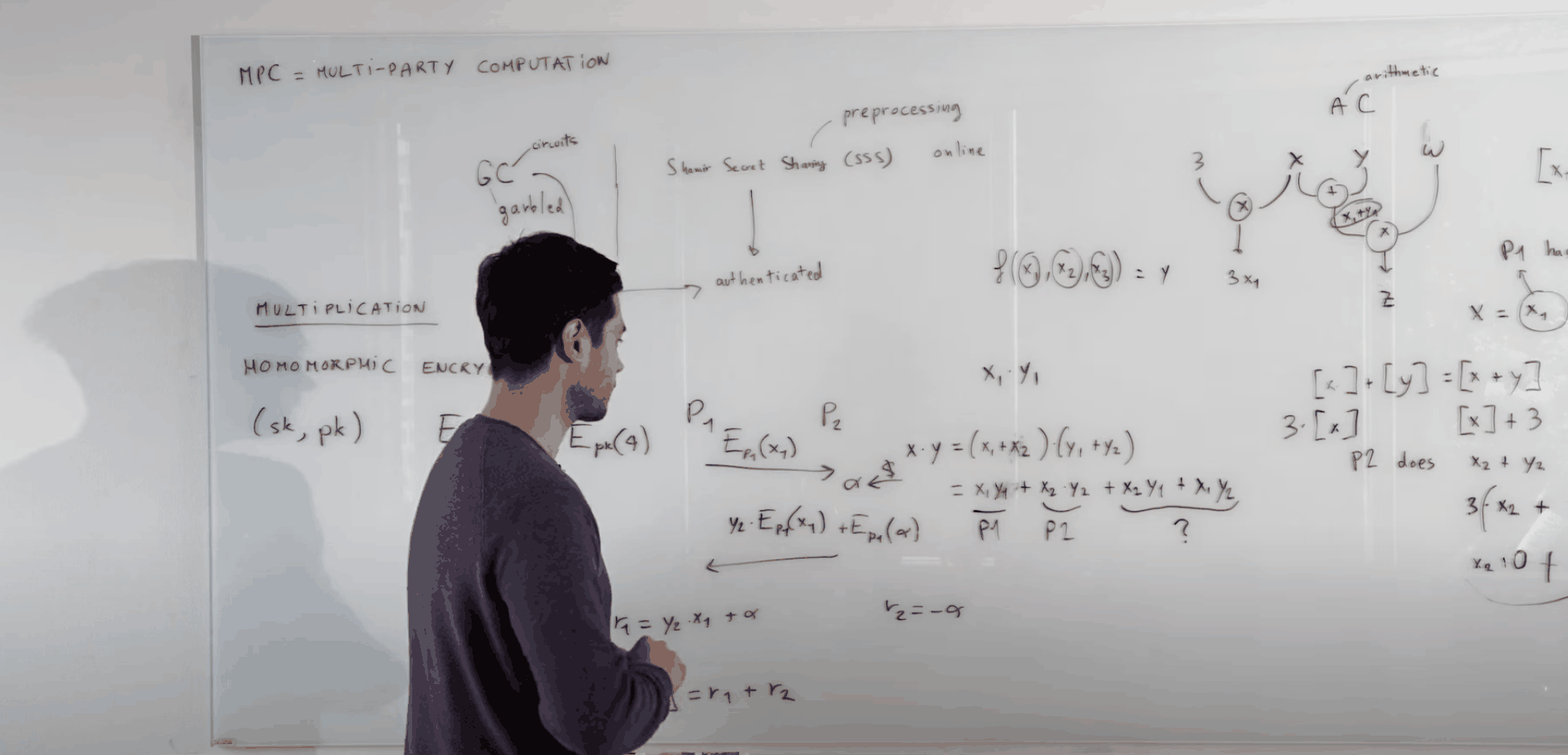
mpc part 2

part 2: Shamir Secret Sharing and multiplications.

Need auditors to look at your MPC stack? Get in touch with us: hello@zksecurity.xyz.

Keep reading
Latest

Circom-Auditor: Open-Source Skills for Finding Vulnerabilities in Circom Code

We are releasing zk-skills, a set of open-source security skills for AI coding agents, starting with circom-auditor: a first line of defense against vulnerabilities in Circom circuits, compatible with both Claude Code and Codex. On the zkbugs benchmark it detects up to 66 of 70 known bugs when pointed at the vulnerable circuits, and up to 40 of 56 when let loose on the full original codebases, far ahead of existing Circom security tools.

Stefanos Chaliasos, Hao Pham, False Witness Team · August 05, 2026

Variants of KZG: Part III, Multilinear Commitments with Zeromorph

In this blog post, we extend univariate KZG commitments to multilinear polynomials through Zeromorph. We introduce the univariatization map, encode the multilinear quotient identity as a univariate identity, and explain why the quotient encodings require degree checks. We then show how Zeromorph batches these checks into a single degree-bounded KZG opening and walk through its end-to-end opening protocol. We conclude by examining its proof size, prover cost, and verifier cost.

Varun Thakore · August 04, 2026

Variants of KZG: Part II, Multilinear Commitments with PST

In this blog post, we extend the ideas behind univariate KZG commitments to multilinear polynomials through the PST commitment scheme. We derive the multilinear quotient identity, explain how PST commits to and opens multilinear polynomials using a specialized multilinear setup and walk through its opening protocol. We conclude by examining the proof size, prover and verifier costs, and the limitations that motivate other multilinear polynomial commitment schemes.

Varun Thakore · July 28, 2026
Recommended

A Gentle Introduction to the MPC-in-the-Head Transformation

In this blog post, we dive into the fascinating world of zero-knowledge proofs using the MPC-in-the-Head transformation, a clever method that constructs proof systems from any secure multiparty computation protocol. Originally proposed in 2007, this transformation uses a creative approach involving "imaginary parties" to prove knowledge without revealing it. We explain how this technique can be applied to develop post-quantum signature schemes, providing insights into its practical implications and efficiency. By exploring these concepts, readers will uncover a unique intersection of cryptography and computer science.

Giorgio Dell'Immagine · February 20, 2025

Watch what we have to say about ZK security in the Node Guardians season 2 episode 1

Catch our cofounder David Wong on the latest episode of Node Guardians, where he chats about ZK security with Sam. Dive into the intriguing world of blockchain auditing, uncover the role math plays, and explore how auditors tackle challenges and rate vulnerabilities. Plus, get insights into the usefulness of formal verification. It's a must-watch for anyone curious about the future of ZK and the nitty-gritty of blockchain security!

ZK/SEC · August 31, 2023

noname meets Ethereum: Integration with SnarkJS

We're excited to share that our programming language, noname, now supports R1CS, making it easier to write zero-knowledge (ZK) circuits and deploy them on Ethereum using SnarkJS. This update introduces an alternative to the common Circom language, with a simple and intuitive syntax inspired by Rust and Golang. In this post, we illustrate how to deploy a noname-based Sudoku circuit on Ethereum, demonstrating core benefits like proving a solution's correctness without revealing it. Dive in to explore how noname could potentially unify the fragmented zkSNARK ecosystem and simplify your circuit writing process!

Katat Choi · June 01, 2024
More to explore

Beyond the Whitepaper: Where BFT Consensus Protocols Meet Reality

We’ve teamed up with Matter Labs and Sigma Zero to dive deep into the security of Byzantine Fault Tolerant (BFT) consensus protocols. In our new paper, we explore real-world vulnerabilities found in BFT systems, including popular algorithms like BA*, HotStuff, and Paxos. You'll discover insights into subtle bugs, cryptographic issues, and the challenges of translating theoretical models into secure, working code. Whether you’re designing or implementing these protocols, our findings offer valuable lessons and strategies for creating more secure and reliable distributed systems. Check it out, it’s a must-read for anyone working with BFT!

ZK/SEC · August 05, 2024

Public report of auditing Penumbra's circuits

We conducted an audit of Penumbra's main circuits and found eight issues, including the critical "double spend" and "double vote" bugs, which the Penumbra team promptly fixed. Our findings highlight Penumbra's robust documentation and code testing. Readers will get insights into how Penumbra uses zero-knowledge proofs for privacy, its decentralized exchange features, and its governance model. The post also provides detailed pseudocode for various cryptographic protocols, emphasizing how Penumbra ensures secure and private transactions. It's a deep dive into the technical details for those intrigued by privacy-focused blockchain technologies.

ZK/SEC · August 24, 2023

Introducing clean, a formal verification DSL for ZK circuits in Lean4

We're diving into our new project called **clean**, aimed at creating an embedded DSL and formal verification framework for Zero Knowledge (ZK) circuits using Lean4. Imagine being able to not only define ZK circuits but also formally prove their correctness. Sounds like a game-changer, right? We'll walk you through our process of building a robust library of reusable, verified circuit gadgets, focusing on the importance of soundness and completeness. Plus, you'll get a peek at some cool examples like 8-bit addition and how we're tackling ZKVM design with techniques borrowed from Fibonacci sequences. It's exciting stuff, and if you're curious about how we're paving the way for bug-free ZK circuits, this is a read you won't want to miss!

Giorgio Dell'Immagine · March 27, 2025