ZK/SEC Research notes from zkSecurity
All posts
zkao · Part 1 of 3

zkao: Security That Compounds

AI vulnerability research is non-deterministic.

That sounds like a problem until you realize it’s also an opportunity: the same model looking at the same code won’t take the same reasoning path every time. Some paths find nothing. Some paths find the bug.

Meaning: a single scan is a coin flip.

In 2025, security researcher Sean Heelan documented this clearly while using OpenAI's o3 on Linux kernel SMB code: the model surfaced the benchmark vulnerability in 8 out of 100 runs, and in many runs it concluded there was no bug. The punchline wasn’t “LLMs are unreliable”. The punchline was:

If you keep running it, you stop needing luck.

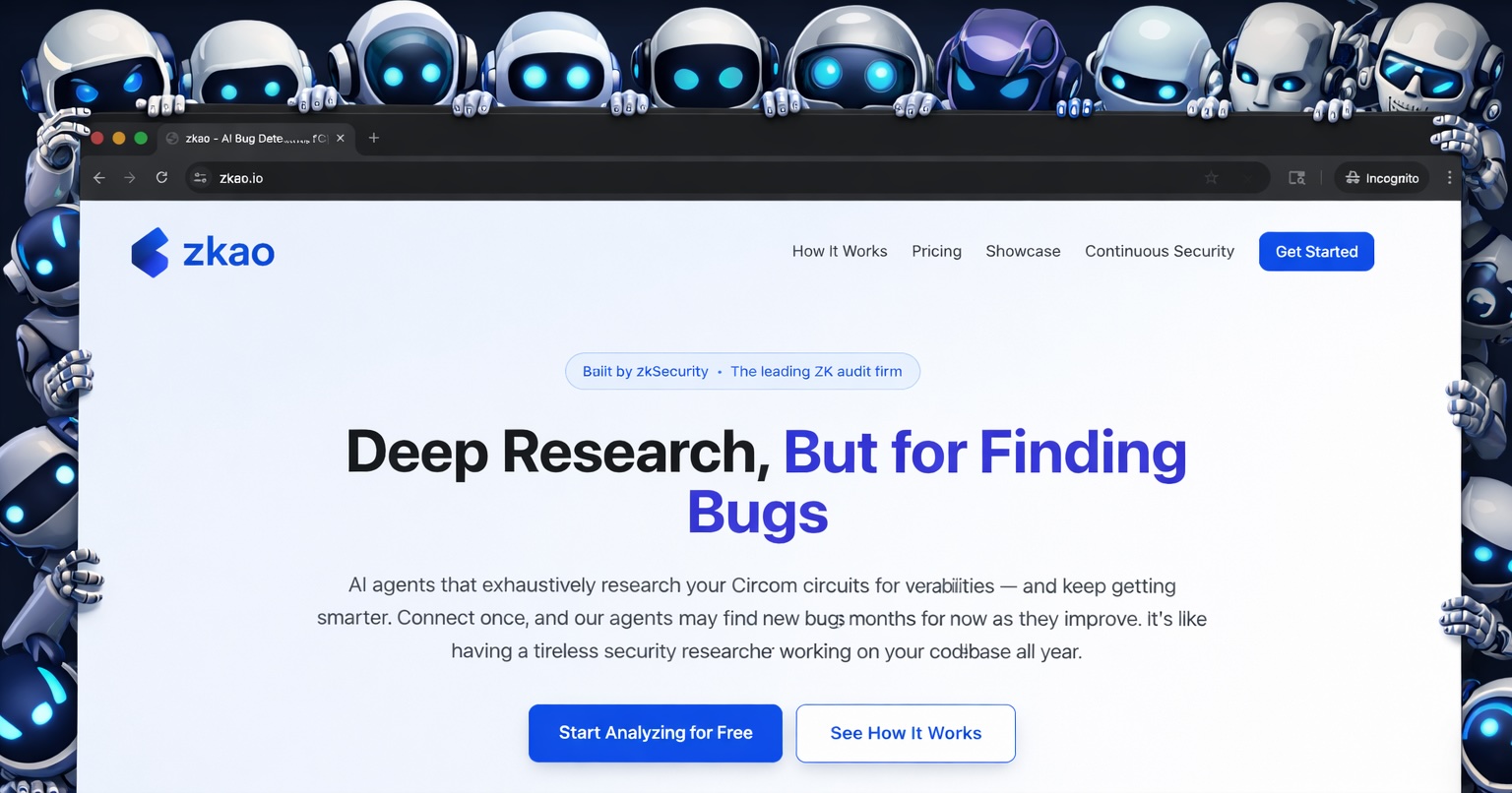
That's the idea behind zkao.

Today we're launching zkao, a product by zkSecurity, built to make AI security research work the way fuzzing works: not as a one-shot event, but as something you run continuously until coverage compounds. We're starting with Circom, a DSL for writing zero-knowledge circuits, where zkSecurity has deep expertise from 100+ audits.

One shot is variance. Repeated runs are coverage.

Fuzzers don’t find the crash on run #1.
They find it on run #14,392.

AI-driven analysis behaves similarly, except the randomness isn't inputs, it's reasoning. Each run explores different angles: data flow, constraint logic, template interactions, edge-case semantics. Some runs get close. Some runs miss. Some runs stumble into the exploit.

So the right unit isn’t “did it find a bug once?”
It’s “what is the probability we’ve covered the dangerous reasoning paths over time?”

That’s what zkao is optimized for.

What zkao does

Connect your GitHub repo once. zkao will:

  • run scans on a schedule (and on demand)
  • re-scan automatically when models improve
  • re-scan when we ship new vulnerability patterns learned from real audits
  • deduplicate findings, so you don’t see the same bug twice
  • surface new results even months later, as coverage improves

You get audit-style reports: concrete findings, exact code locations, and recommendations, optimized for signal, not volume.

Built from audit reality, not generic “AI security”

zkao isn’t trained on vibes. It’s informed by what we see in practice.

zkSecurity has completed 100+ ZK system audits, with Circom being the most common DSL. Every engagement teaches new failure modes (under-constrained signals, unsafe assignments, missing range checks, subtle cross-template logic flaws) and those patterns get encoded into the agents that run on your codebase.

So your coverage improves along three axes:

  1. models get better

  2. our patterns get richer

  3. probability compounds with repeated runs

Even if your code doesn’t change, your security coverage does.

Pre-audit, post-audit, or always-on

Use zkao to:

  • catch avoidable issues before a human audit
  • complement a completed audit with continuous scanning
  • keep coverage compounding between releases

Audits remain the gold standard. zkao is how you keep the pressure on after the snapshot.

Try it

zkao is now in early access.

If you have Circom circuits and you want security research that keeps getting smarter over time, start here: zkao

Want to get early access? Reach out at zksecurity.xyz/contact.

Security shouldn't be a one-time event. It should compound.

Keep reading
Latest

Optimizing Cryptography with AI

Many of us are using AI to generate code. Vibe coding cryptography is especially sensitive - you have to uphold strict mathematical correctness. This can lead to wrong security guarantees and soundness bugs. We will discuss what are some patterns to do it well.

Kobi Gurkan · August 11, 2026

Introducing zkvmBlast: Differential Fuzzing for Ethereum's zkVMs

zkVMs are moving to the center of Ethereum's roadmap, which means a bug in a zkVM is turning into a bug in Ethereum itself. We built zkvmBlast, a zkVM-agnostic differential fuzzer that runs the same program across SP1, RISC0, OpenVM, Pico, Zisk, and Airbender against a reference simulator and flags any disagreement. It hunts for both soundness and completeness bugs, with a deliberate focus on completeness, an under-explored class that can turn a single valid block into a liveness failure. We share the first batch of findings.

Stefanos Chaliasos, Martín Ochoa, Varun Thakore · August 10, 2026

Circom-Auditor: Open-Source Skills for Finding Vulnerabilities in Circom Code

We are releasing zk-skills, a set of open-source security skills for AI coding agents, starting with circom-auditor: a first line of defense against vulnerabilities in Circom circuits, compatible with both Claude Code and Codex. On the zkbugs benchmark it detects up to 66 of 70 known bugs when pointed at the vulnerable circuits, and up to 40 of 56 when let loose on the full original codebases, far ahead of existing Circom security tools.

Stefanos Chaliasos, Hao Pham, False Witness Team · August 05, 2026
Recommended

Bug Hunt: Zero-Knowledge, Full-Paranoia, and the AI That Stares Back

Over the past year, we've been diving into whether AI can effectively identify bugs in zero-knowledge circuits and applications, sparking questions about the future of auditing. This led us to develop SnarkSentinel, an AI-powered auditing tool. We'll share what worked, what didn’t, and how our journey with AI could impact auditing. From early challenges with Circom to innovative methods like retrieval-augmented generation and agent-led probing, we'll give you a peek into our findings, including both successes and setbacks with bug detection. Discover how AI might enhance or change the landscape of auditing and what this means for developers and security pros alike.

ZK/SEC · July 03, 2025

When LLM Review Cryptography Papers

Google Research used Gemini to find a bug in a cryptography paper on SNARGs from LWE. We summarize how those events unfolded, look at their iterative self-correction prompting strategy and discuss the growing role of LLMs in academic research.

Nicolas Mohnblatt · February 10, 2026

The First ZK Exploits Happened, and They Weren't What We Expected

The first two known exploits against live ZK circuits happened in the past week. Both stem from the same root cause. They were not subtle underconstrained bugs, but rather Groth16 verifiers (generated by snarkjs) with an incorrect setup (just missing the last step). One was exploited by white-hat hackers for ~$1.5M, the other was drained for 5 ETH.

Stefanos Chaliasos, Hao Pham · February 27, 2026
More to explore

Trust, But Measure: A Friendly Intro to TEEs with Intel TDX

In the latest session of "Proof is in the Pudding," we teamed up with Archetype to explore the basics of Trusted Execution Environments. Through a collaborative whiteboarding session, we break down key concepts and practical applications, making this tech topic accessible and engaging. Dive in to discover how these environments can enhance digital security in a straightforward way.

ZK/SEC · June 28, 2025

Stay in Range: Deeper Into Bulletproofs

This article breaks down how Bulletproofs enable range proofs: proofs that a hidden value lies within a range without revealing it. Starting from bit decomposition, it shows how to express and combine constraints into a single inner product, then make the proof zero-knowledge with blinding polynomials and commitments. By the end, you’ll understand how systems like Monero’s confidential transactions prove valid amounts while keeping values private.

teddav · November 12, 2025

Comparison of formal verification frameworks for arithmetic circuits

A hands-on comparison of formal verification frameworks for arithmetic circuits, evaluating those in the ACL2 Book (r1cs, PFCS), acl2-jolt, Garden (Rocq), zk-lean, sp1-lean, and Clean. Each framework is tested on reproducibility, available examples (from basic field elements to RISC-V VM instructions), and practical verification tasks including the IsZero and weighted-sum circuits. The evaluation includes both human and Claude Code's ability to work with each framework, revealing insights about installation difficulty, proof automation capabilities, and the maturity of publicly available examples. This post maps the current landscape of formally verified ZK circuits and discusses what's coming next in this rapidly evolving field.

Yoichi Hirai · November 19, 2025