
ZK/SEC Research notes from zkSecurity
All posts
announcement · zk

zkBitcoin: Use Zero-Knowledge Applications (zkapps) on Bitcoin

zkbitcoin

In collaboration with Σ0, we released a new primitive called zkBitcoin, which allows for the creation of zero-knowledge applications (zkapps) on Bitcoin via a minimal layer 2 protocol that uses Bitcoin as data availability layer and a committee of participants to perform threshold signatures.

This is a significant milestone for the Bitcoin ecosystem as it augments the capability of the Bitcoin scripting language allowing for larger and more complex application. In addition, it unlocks privacy-preserving applications for Bitcoin.

We're currently running on testnet, and you can try it out by downloading the zkBitcoin CLI.

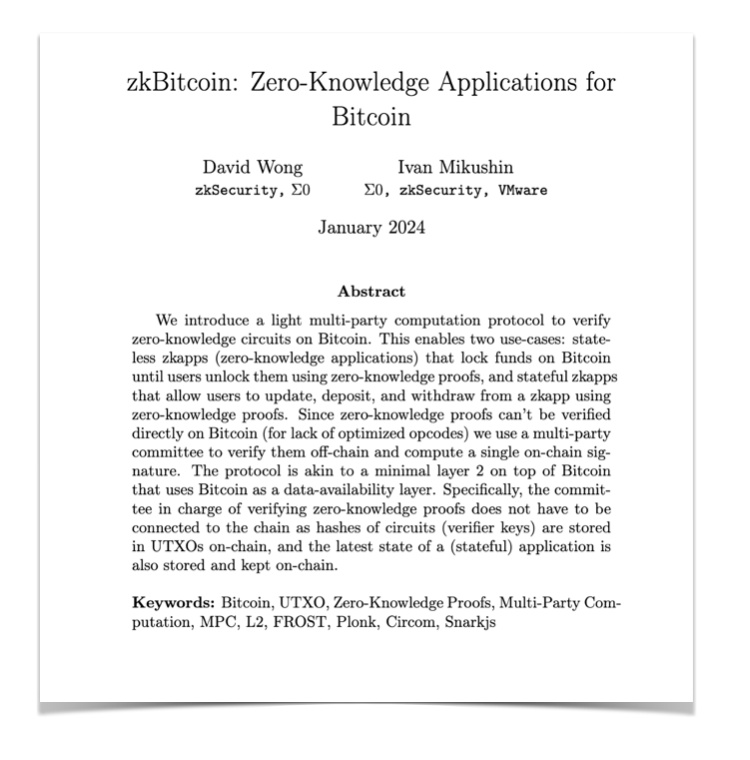
You can read the whitepaper here, which describes the two types of zkapps that can be created, stateless and stateful, while providing more details about the protocol overall:
zkbitcoin

If you like videos, you can watch:

We're excited to see what people will build on top of zkBitcoin. If you're interested in running a node for the network, or interested in using the protocol for your own application or L2, shoot us a message!

Keep reading
Recommended

Archetype x zkSecurity - Proof is in the Pudding: ZK on Bitcoin

In Session 09 of "Proof is in the Pudding," we explore the intersection of zero-knowledge proofs and Bitcoin. We break down Bitcoin's UTXO model and Script limitations, then dive deep into approaches for verifying ZK proofs on Bitcoin, from MPC-based techniques to BitVM's optimistic verification with fraud proofs. We cover timelocks, the statelessness problem and Lamport signatures for state, Taproot, simulated covenants, BitVM 3 with hashlocks and garbled circuits, cut-and-choose security, and witness encryption (BABE).

ZK/SEC · April 02, 2026

Reproducing and Exploiting ZK Circuit Vulnerabilities

Check out our latest blog post where we dive into the world of Zero-Knowledge Proof (ZKP) vulnerabilities, sharing our insights from replicating known ZK circuit weaknesses. We’ve launched a GitHub repo with detailed scripts to help you understand, reproduce, and learn from these vulnerabilities. Discover how this hands-on approach aids in grasping attack vectors, testing fixes, and enriching educational resources. Whether you're a researcher or a developer, this post is packed with info to enhance your knowledge and skills in ZKP security. Plus, find out how you can contribute to expanding this invaluable resource!

Stefanos Chaliasos, Chenyang Yu · August 09, 2024

zkSecurity took part in judging the latest zkHack Montreal

We recently had the thrill of judging the latest zkHack competition in Montreal, where developers, researchers, and enthusiasts dove into the world of zero-knowledge proofs and privacy tech. The projects were incredibly innovative, featuring creative applications like ZK breathalyzers and ZK & GPS solutions. Check out the exciting results and insights from this year's event. You won't want to miss what these brilliant minds are bringing to the table!

ZK/SEC · September 02, 2024
More to explore

Auditing Self: Collaborating with Celo on Privacy and Identity Infrastructure

We recently teamed up with Celo for an in-depth security audit of the Self project, exploring its innovative approach to on-chain identity using biometric passports and zero-knowledge proofs. During our three-week dive, we examined everything from cryptographic primitives to smart contract architecture and a unique proof delegation system using AWS Nitro Enclaves. The Celo team impressed us with their commitment and responsiveness, and we collaborated on refining the system with strategic improvements. Curious about the nitty-gritty details and our insights? Check out the full report!

ZK/SEC · March 24, 2025

Cryptography challenges @KalmarCTF 2026

Minsun shares a high-level overview of the hard cryptography challenges he authored for KalmarCTF 2026, focusing on the broader ideas behind their design and solutions. The post reflects on how subtle randomness failures and algebraic structure can lead to deep vulnerabilities.

Minsun Kim · April 28, 2026

Playing with LaBRADOR: Building Compact Lattice-based Proofs with Recursion

In this post, we explore LaBRADOR, a transparent, lattice-based proof system that achieves sublinear proof sizes through recursion. Built on the Module-SIS assumption, LaBRADOR lets a prover efficiently demonstrate knowledge of short vectors satisfying dot product constraints, general enough to express R1CS. The protocol’s key ideas include amortized openings, outer commitments, and a strategy to shrink the witness after each round of recursion. Together, these techniques make LaBRADOR a powerful, scalable framework for post-quantum zero-knowledge proofs.

Georgios Raikos · November 13, 2025