ZK/SEC Research notes from zkSecurity
All posts
zkbugs · Part 2 of 2

Introducing bugs.zksecurity.xyz a knowledge base for ZK bugs

zkbugs website

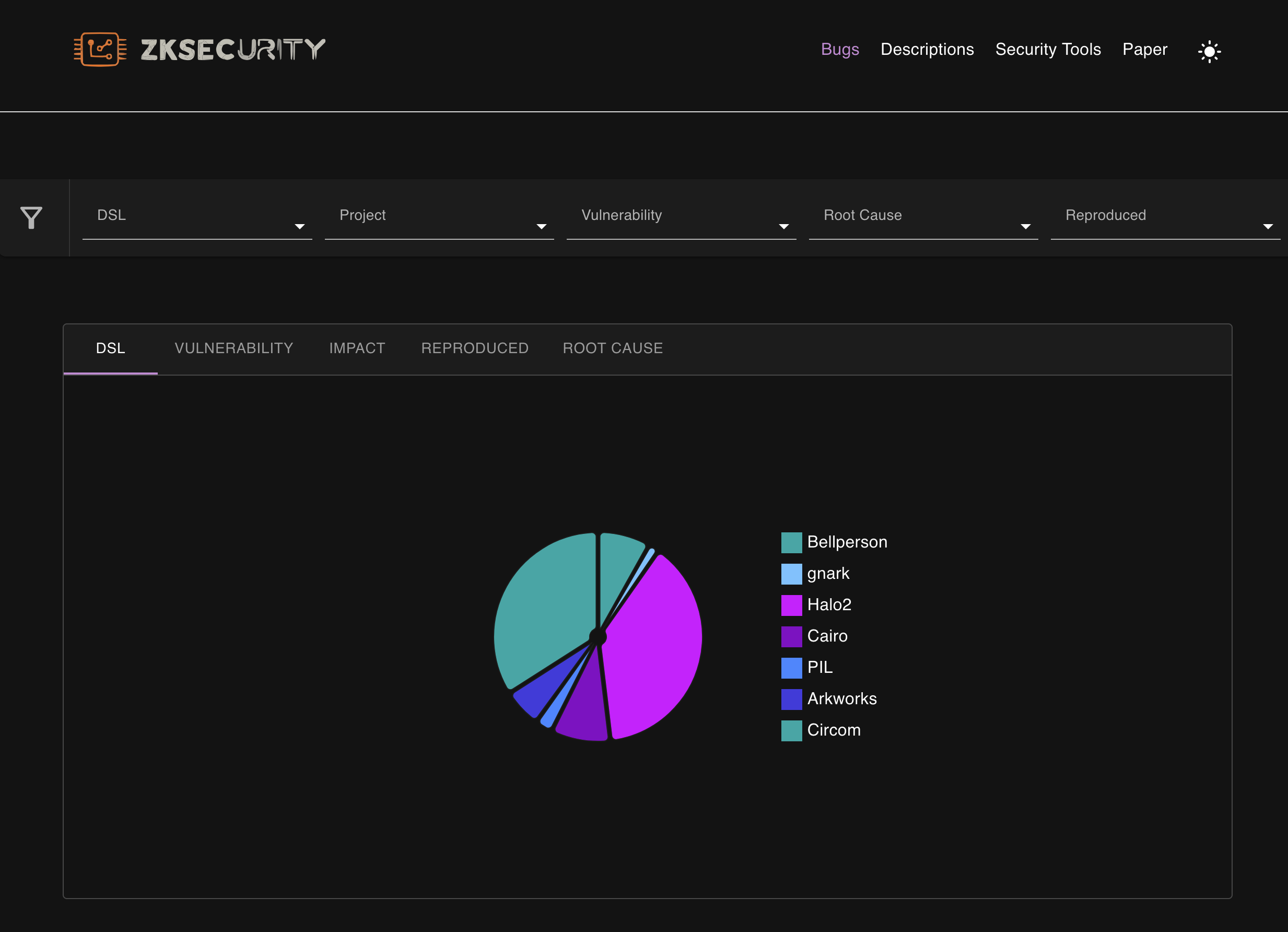
We are excited to announce the launch of bugs.zksecurity.xyz, a website dedicated to documenting and analyzing past vulnerabilities in ZK circuits. This website serves as an open repository where developers, researchers, and security professionals can explore past security issues, reproduce known vulnerabilities, and contribute to improve this knowledgebase.

On the website and the zkbugs repo, you will find:

  • A Catalog of ZK Bugs: A growing dataset of known vulnerabilities in ZK circuits, each documented with descriptions, root causes, and potential mitigations.
  • Bug Reproduction Reports: A collection of bugs we have successfully reproduced, with accompanying scripts.
  • Security Tools List: A list of available security tools for different ZK DSLs.
  • Tool Evaluations: Results from our assessments of different security tools against reproduced bugs, providing insights into their strengths and weaknesses.
  • Contribution Guidelines: Instructions on how you can participate in expanding the dataset, reproducing bugs, or improving the website.

Expanding the zkBugs Dataset

In our previous blog posts, we introduced the zkBugs repository -- a comprehensive collection of known vulnerabilities in ZK circuits -- and discussed the state of security tools for ZKPs. Today, we're excited to share significant updates to the zkBugs dataset and our ongoing efforts to build a thorough and updated knowledge base.

We have expanded the zkBugs dataset to include a total of 89 documented bugs, providing a broader spectrum of vulnerabilities for study and analysis. Out of these, we have successfully reproduced 22 vulnerabilities. Each reproduced bug is accompanied by comprehensive, end-to-end scripts that demonstrate the exploit.

Evaluating Security Tools

Further, we have evaluated two prominent tools -- Circomspect and Picus -- against the 22 reproduced bugs. The evaluation results are available in the zkBugs repository:

  • Circomspect: A static analysis tool designed to detect underconstrained vulnerabilities in Circom circuits. Our evaluation provides insights into its effectiveness and areas for improvement.
  • Picus: A formal verification tool that uses symbolic execution to identify potential flaws in Circom circuits. The assessment highlights its strengths in ensuring circuit correctness but also demonstrates potential scalability concerns.

Future Directions

Our journey doesn't end here. We plan to continue reproducing additional bugs and enriching the dataset with new findings. By expanding the repository, we aim to create a more comprehensive resource that reflects the evolving landscape of ZK vulnerabilities.

Call for Contributions

We believe that collaborative efforts are key to enhancing the security of ZK applications. We warmly welcome contributions from the community in various forms:

  • Adding New Bugs: If you're aware of vulnerabilities not yet included in our dataset, please consider contributing by adding them.
  • Reproducing Bugs: Assist in reproducing documented bugs to provide deeper insights and validation.
  • Tool Evaluation Scripts: Develop scripts to evaluate additional tools against the vulnerabilities in our dataset.
  • Website Improvements: Enhance the functionality and user experience of our website to make information more accessible.
  • Issue Reporting: Open issues for bugs you'd like to see included or reproduced, or suggest improvements to our existing resources.

Your contributions are invaluable in building a robust knowledge base that benefits the entire community.

Looking Ahead

We envision the zkBugs repository as more than just a collection of vulnerabilities. Our goal is to establish a knowledge base that serves both educational and research purposes, helping individuals learn from past vulnerabilities and fostering advancements in the field. As the ZK ecosystem continues to grow, we aim to develop a community-driven advisory platform that will provide notifications for critical bugs in the most important projects and libraries of the space.

Stay tuned for more updates, and we look forward to your active participation.

Acknowledgements

This project has been partially funded by the EF with support from Aztec, Polygon, Scroll, Taiko, and zkSync.

Keep reading
Latest

Optimizing Cryptography with AI

Many of us are using AI to generate code. Vibe coding cryptography is especially sensitive - you have to uphold strict mathematical correctness. This can lead to wrong security guarantees and soundness bugs. We will discuss what are some patterns to do it well.

Kobi Gurkan · August 11, 2026

Introducing zkvmBlast: Differential Fuzzing for Ethereum's zkVMs

zkVMs are moving to the center of Ethereum's roadmap, which means a bug in a zkVM is turning into a bug in Ethereum itself. We built zkvmBlast, a zkVM-agnostic differential fuzzer that runs the same program across SP1, RISC0, OpenVM, Pico, Zisk, and Airbender against a reference simulator and flags any disagreement. It hunts for both soundness and completeness bugs, with a deliberate focus on completeness, an under-explored class that can turn a single valid block into a liveness failure. We share the first batch of findings.

Stefanos Chaliasos, Martín Ochoa, Varun Thakore · August 10, 2026

Circom-Auditor: Open-Source Skills for Finding Vulnerabilities in Circom Code

We are releasing zk-skills, a set of open-source security skills for AI coding agents, starting with circom-auditor: a first line of defense against vulnerabilities in Circom circuits, compatible with both Claude Code and Codex. On the zkbugs benchmark it detects up to 66 of 70 known bugs when pointed at the vulnerable circuits, and up to 40 of 56 when let loose on the full original codebases, far ahead of existing Circom security tools.

Stefanos Chaliasos, Hao Pham, False Witness Team · August 05, 2026
Recommended

Reproducing and Exploiting ZK Circuit Vulnerabilities

Check out our latest blog post where we dive into the world of Zero-Knowledge Proof (ZKP) vulnerabilities, sharing our insights from replicating known ZK circuit weaknesses. We’ve launched a GitHub repo with detailed scripts to help you understand, reproduce, and learn from these vulnerabilities. Discover how this hands-on approach aids in grasping attack vectors, testing fixes, and enriching educational resources. Whether you're a researcher or a developer, this post is packed with info to enhance your knowledge and skills in ZKP security. Plus, find out how you can contribute to expanding this invaluable resource!

Stefanos Chaliasos, Chenyang Yu · August 09, 2024

zkSecurity took part in judging the latest zkHack Montreal

We recently had the thrill of judging the latest zkHack competition in Montreal, where developers, researchers, and enthusiasts dove into the world of zero-knowledge proofs and privacy tech. The projects were incredibly innovative, featuring creative applications like ZK breathalyzers and ZK & GPS solutions. Check out the exciting results and insights from this year's event. You won't want to miss what these brilliant minds are bringing to the table!

ZK/SEC · September 02, 2024

zkao: Security That Compounds

Today we're launching zkao, a product by zkSecurity that makes AI security research work the way fuzzing works: not as a one-shot event, but as something you run continuously until coverage compounds.

ZK/SEC · February 07, 2026
More to explore

Playing with LaBRADOR: Building Compact Lattice-based Proofs with Recursion

In this post, we explore LaBRADOR, a transparent, lattice-based proof system that achieves sublinear proof sizes through recursion. Built on the Module-SIS assumption, LaBRADOR lets a prover efficiently demonstrate knowledge of short vectors satisfying dot product constraints, general enough to express R1CS. The protocol’s key ideas include amortized openings, outer commitments, and a strategy to shrink the witness after each round of recursion. Together, these techniques make LaBRADOR a powerful, scalable framework for post-quantum zero-knowledge proofs.

Georgios Raikos · November 13, 2025

Public report of Aleo's consensus (Bullshark)

We recently audited Aleo's blockchain consensus and found it to be impressively well-documented and high-quality. Our collaboration with Aleo's cooperative team helped us uncover several key issues, and the insights from this audit were well-received. In the blog, we dive into Aleo's Bullshark consensus protocol, explaining its step-by-step process and unique pipelining techniques. We also explore how leaders ensure commitments in even rounds and discuss essential aspects like quorum intersection and garbage collection. Whether you're a blockchain enthusiast or just curious about cutting-edge consensus protocols, this post has got some fascinating details to offer!

ZK/SEC · January 02, 2024

Become a Halo2 Hero: Master Zero-Knowledge Proofs with Our New Course

We're teaming up with the Zircuit team to bring you a new course on Halo2 development that's perfect for Rust developers eager to dive into creating Halo2 circuits from scratch. No need to be a cryptographer or have prior knowledge of Halo2, PlonK, or zkSNARKs. Our course starts with the basics and guides you through building increasingly complex circuits. By the end, you'll be a Halo Hero! Plus, you'll have access to complete, runnable code examples on GitHub. Ready to start your Halo2 journey? Check it out!

Mathias Hall-Andersen · November 14, 2024