ZK/SEC Research notes from zkSecurity
All posts
announcement

zkNews Is Now Open to Everyone

A while back we announced zkNews, a zero-knowledge link aggregator for the community. At the time we launched in beta, with access limited to a smaller group of users while we made sure everything held up.

Today we're happy to share that the gates are open: zkNews is no longer rate-limited, and anyone can sign up.
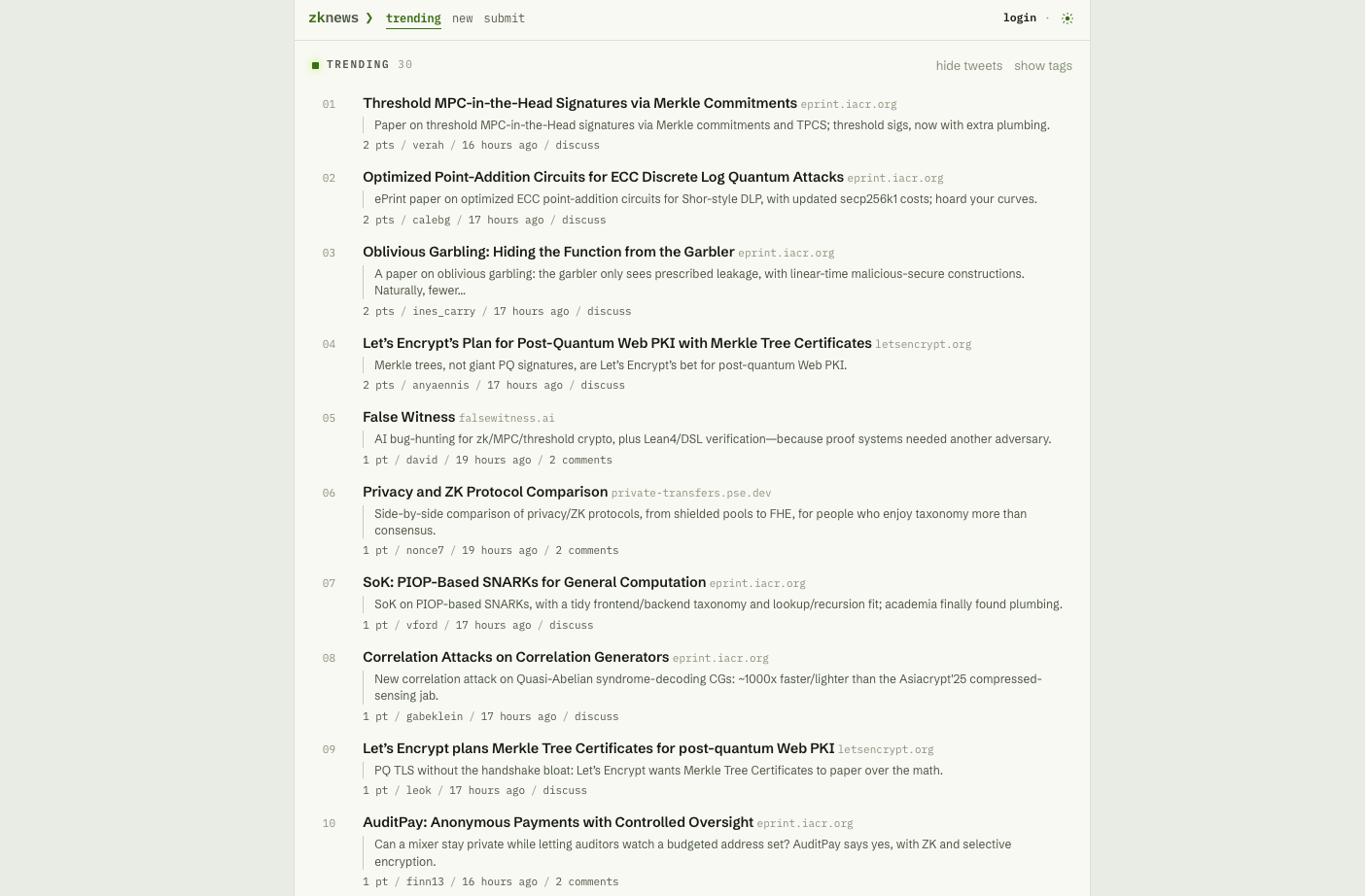
zknews

What changed?

When we first launched, sign-ups were capped so we could keep an eye on stability and quality while the platform was young. We've since had time to iron things out, and we're confident zkNews is ready for a bigger crowd.

That means you no longer need an invite or a spot on a waitlist. Head over to news.zksecurity.xyz, create an account, and you're in.

What can you do now?

  • Submit links: Found a great paper, talk, or project? Share it with the community.
  • Discuss: Jump into the comments on trending posts and add your perspective.
  • Vote: Help surface the best content by upvoting what you find valuable.

Same mission

Nothing has changed about what zkNews is for. It's still your one-stop shop for the latest news, research, and projects in the zero-knowledge space. The only difference is that the door is now open to everyone.

Come join us at news.zksecurity.xyz, and follow us on twitter for updates and announcements.

Keep reading
Latest

The Year Finding and Exploiting Bugs Became Cheap, and What to Do About It

The economics of security have changed. AI has made finding and exploiting bugs cheaper, including in cryptographic and zero-knowledge code, while validation and remediation remain slow. Here is our view of what happened, what comes next, and how teams should change the way they secure their stack to defend against AI-assisted attackers.

Stefanos Chaliasos · September 07, 2026

Variants of KZG: Part V, Multilinear Commitments with Mercury

In this final post of the series, we extend univariate KZG commitments to multilinear polynomials through Mercury. Building on Gemini, we fold half of the variables at once, use polynomial division to bind this large fold to the original commitment and reduce the remaining multilinear evaluations to a batched inner product check. We then walk through the end-to-end opening protocol. We conclude by examining its proof size, prover cost and verifier cost.

Varun Thakore · August 17, 2026

Variants of KZG: Part IV, Multilinear Commitments with Gemini

In this blog post, we extend univariate KZG commitments to multilinear polynomials through Gemini. We introduce recursive partial evaluations, derive the split-and-fold identity and express each fold as a univariate identity that can be checked using KZG openings. We then walk through the end-to-end opening protocol. We conclude by examining its proof size, prover cost, and verifier cost.

Varun Thakore · August 12, 2026
Recommended

Ditch the Pump & Dump Drama: Your ZK Tech Hub Awaits

We're excited to share our latest project, zkNews, your go-to hub for all things zero-knowledge. This link aggregator keeps you updated with the latest ZK news, groundbreaking research, and cutting-edge projects. Dive into the ZK world, stay informed with breaking announcements, and explore innovative tools and applications. Join our beta and help shape the future of zkNews with your feedback. Big plans are in the works, and we'd love you to be a part of it!

ZK/SEC · May 31, 2024

SoK: What don’t we know? Understanding Security Vulnerabilities in SNARKs

We've teamed up with some of the top minds in academia and industry to dive deep into the world of zero-knowledge proofs (ZKPs) and their vulnerabilities. Our new paper catalogues hundreds of ZK vulnerabilities, breaking down their root causes and offering strategies to sidestep these pitfalls. By digging into real-life SNARK implementations, we aim to bolster the security of these cutting-edge systems with actionable insights and recommendations. Curious about what makes ZKPs tick and how to keep them secure? You might find this study just what you need!

ZK/SEC · February 26, 2024

Listen to us on the latest episode of zeroknowledge.fm

Join our cofounder David Wong on the latest zk podcast as he dives into his compelling journey through cryptography, from his early days as a security consultant to his pivotal roles in major projects like Facebook's crypto initiatives and Mina. Get an insider's view on how we approach auditing in a Zero Knowledge context, the common pitfalls in ZK code, and how these insights shape our work. It's an engaging and informative chat for anyone fascinated by the world of cryptography and ZK technology!

ZK/SEC · August 30, 2023
More to explore

Stone CLI: Making Cairo programming more accessible

We're excited to introduce the Stone CLI, our new tool designed to simplify the process of proving and verifying Cairo programs. Working alongside the StarkWare team, we've streamlined the toolchain for developers, making it easier to compile, run, and prove these programs with less hassle. You'll get the scoop on how to seamlessly use the Stone CLI across various verifiers, serialize proofs, and even create Ethereum-compliant proofs using the bootloader. Dive in to see how we're making life easier for both beginners and seasoned Cairo enthusiasts!

Jason Park · November 10, 2024

Kocher's Timing Attack: A Journey from Theory to Practice

Paul Kocher's 1996 timing attack showed how microsecond differences in execution time could leak private keys from RSA implementations. This tutorial recreates the attack journey from clean operation counting through noisy wall-clock measurements to sophisticated engineering solutions. Learn the variance distinguisher, explore schoolbook modular arithmetic, and discover the measurement techniques that make practical timing attacks possible despite system noise.

Martín Ochoa · September 19, 2025

noname: ZK app developers should be able to see down to the constraints

Zero-knowledge apps are evolving, and we've been diving into their two main forms: VM instructions and arithmetic circuits. Understanding the "assembly" layer is crucial for developers, especially when optimizing and ensuring security. We’ve played around with a new toy language called **noname**, blending Golang and Rust vibes to make zkApps more understandable. With **noname**, you get detailed insights about how your code translates into gates, offering a clearer picture of the underlying "assembly" and helping pinpoint compiler bugs. If you're curious about enhancing your low-level programming skills or peeking into circuit construction, check out our experiments and see if this inspires you to create better debugging tools!

David Wong · June 03, 2023