ZK/SEC Research notes from zkSecurity
All posts
educative · zk

zkHack x zkSecurity (Whiteboard Session) - What is Zero-Knowledge (like, actually)?

What is Zero-Knowledge (like, actually)?

zkSecurity is helping zkHack kick off a new season of zkHack whiteboard sessions!

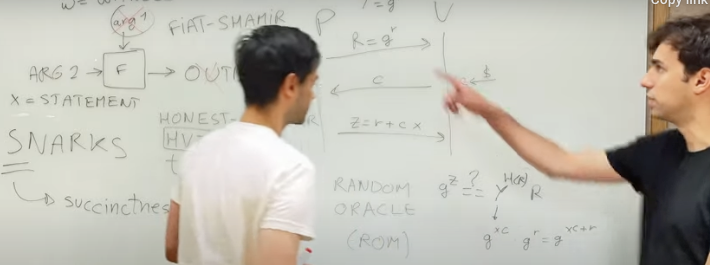
In this module, Nicolas Mohnblatt and David Wong from zkSecurity dig into the term “Zero Knowledge” and discuss what this property actually is, when it is being used (or not) and what characteristics some systems need in order to be considered truly ZK. They then highlight the different types of ZK (perfect, statistical, and computational), discuss the distinction between dishonest and honest verifiers, and the preference for adaptive models over non-adaptive ones. Additionally, they explore methods for generating hiding commitments from techniques such as KZG, Pedersen, and hashes, and conclude with an overview of the zero-knowledge analysis of PLONK.

watch it on youtube or on the zkhack.dev page

What's in it? Check the timestamps:

00:00 – Introduction 01:03 – ZK, SNARKs, Proving… High-level overview 04:53 – Defining ZK and the concept of Simulator 08:41 – A concrete example of a Simulator with the Schnorr Identity Protocol 14:06 – Honest vs. dishonest Verifier 19:28 – Non-interactive to interactive protocol with Fiat-Shamir 24:50 – The 3 flavors of ZK 29:52 – Application to the PLONK protocol 46:37 – Managing KZG and its trusted setup 50:00 – The ZK flavor of PLONK 57:02 – Summary

Keep reading
Latest

Circom-Auditor: Open-Source Skills for Finding Vulnerabilities in Circom Code

We are releasing zk-skills, a set of open-source security skills for AI coding agents, starting with circom-auditor: a first line of defense against vulnerabilities in Circom circuits, compatible with both Claude Code and Codex. On the zkbugs benchmark it detects up to 66 of 70 known bugs when pointed at the vulnerable circuits, and up to 40 of 56 when let loose on the full original codebases, far ahead of existing Circom security tools.

Stefanos Chaliasos, Hao Pham, False Witness Team · August 05, 2026

Variants of KZG: Part III, Multilinear Commitments with Zeromorph

In this blog post, we extend univariate KZG commitments to multilinear polynomials through Zeromorph. We introduce the univariatization map, encode the multilinear quotient identity as a univariate identity, and explain why the quotient encodings require degree checks. We then show how Zeromorph batches these checks into a single degree-bounded KZG opening and walk through its end-to-end opening protocol. We conclude by examining its proof size, prover cost, and verifier cost.

Varun Thakore · August 04, 2026

Variants of KZG: Part II, Multilinear Commitments with PST

In this blog post, we extend the ideas behind univariate KZG commitments to multilinear polynomials through the PST commitment scheme. We derive the multilinear quotient identity, explain how PST commits to and opens multilinear polynomials using a specialized multilinear setup and walk through its opening protocol. We conclude by examining the proof size, prover and verifier costs, and the limitations that motivate other multilinear polynomial commitment schemes.

Varun Thakore · July 28, 2026
Recommended

zkBank: you think you have what it takes to work at zkSecurity?

Join us as we dive into the world of ZK through an exciting challenge called zkBank! Whether you're a bug-hunting enthusiast or just curious about zero-knowledge projects, this is your chance to test your skills and learn across various areas. Think you can crack it? Check out the details and see if you have what it takes.

ZK/SEC · February 27, 2024

zkBitcoin: Use Zero-Knowledge Applications (zkapps) on Bitcoin

We're excited to introduce zkBitcoin, a new tool that lets you create zero-knowledge applications on Bitcoin using a minimal layer 2 protocol. This innovation opens up a world of complex, privacy-focused apps by enhancing Bitcoin's scripting capabilities. We're currently on testnet, so you can jump in and explore the possibilities. Check out our whitepaper or watch some videos for a deeper dive. It's an exciting time for Bitcoin development, and we can't wait to see what you'll build!

David Wong · January 31, 2024

Introducing bugs.zksecurity.xyz a knowledge base for ZK bugs

We're thrilled to introduce our new site, [bugs.zksecurity.xyz](https://bugs.zksecurity.xyz/), a hub for exploring past vulnerabilities in ZK circuits. Dive into our growing catalog of documented bugs and learn how we've reproduced some with comprehensive scripts. Discover evaluations of prominent security tools like Circomspect and Picus, and see where they shine or stumble. We're calling on the community to join us in expanding this invaluable resource, whether by adding bugs, reproducing them, or improving our platform. Let's collaborate to elevate ZK security together!

Stefanos Chaliasos · February 17, 2025
More to explore

Archetype x zkSecurity - Proof is in the Pudding: ZK on Bitcoin

In Session 09 of "Proof is in the Pudding," we explore the intersection of zero-knowledge proofs and Bitcoin. We break down Bitcoin's UTXO model and Script limitations, then dive deep into approaches for verifying ZK proofs on Bitcoin, from MPC-based techniques to BitVM's optimistic verification with fraud proofs. We cover timelocks, the statelessness problem and Lamport signatures for state, Taproot, simulated covenants, BitVM 3 with hashlocks and garbled circuits, cut-and-choose security, and witness encryption (BABE).

ZK/SEC · April 02, 2026

zkVM Security: What Could Go Wrong?

Ever wondered how zkVMs simplify the use of zero-knowledge proofs in coding? We dive into how they let developers focus more on application logic by abstracting complex cryptographic aspects, using familiar languages like Rust or C++. But hold on, it's not all smooth sailing. Despite these benefits, a single bug anywhere in the complex system of compilers, proof systems, or verification can lead to serious security issues. In the post, we break down the zkVM workflow, explore common vulnerabilities at each phase, and highlight the importance of understanding these layers to build more secure, zk-powered applications. Curious about how this all plays out? Let’s unravel it together!

Suneal Gong · November 21, 2024

Clean: From Verified Circuits to Verified zkVMs

Clean, our circuit DSL, is growing toward verification of complex multi-AIR ensembles. We introduce channels as a way to model lookups, permutation arguments, and zkVM cross-table interactions, then explain how local gadget proofs can compose into global soundness theorems. Watch our talk from ZKProof 8 or read the post.

Gregor Mitscha-Baude · June 05, 2026