ZK/SEC Research notes from zkSecurity
All posts

New Challenge Alert: Complete Both to Join zkSecurity

new challenge

We're always on the lookout for passionate people to join us to work on the most exciting projects in the ZK space. After launching our first hiring challenge, zkBank, we're excited to announce that we're raising the bar!

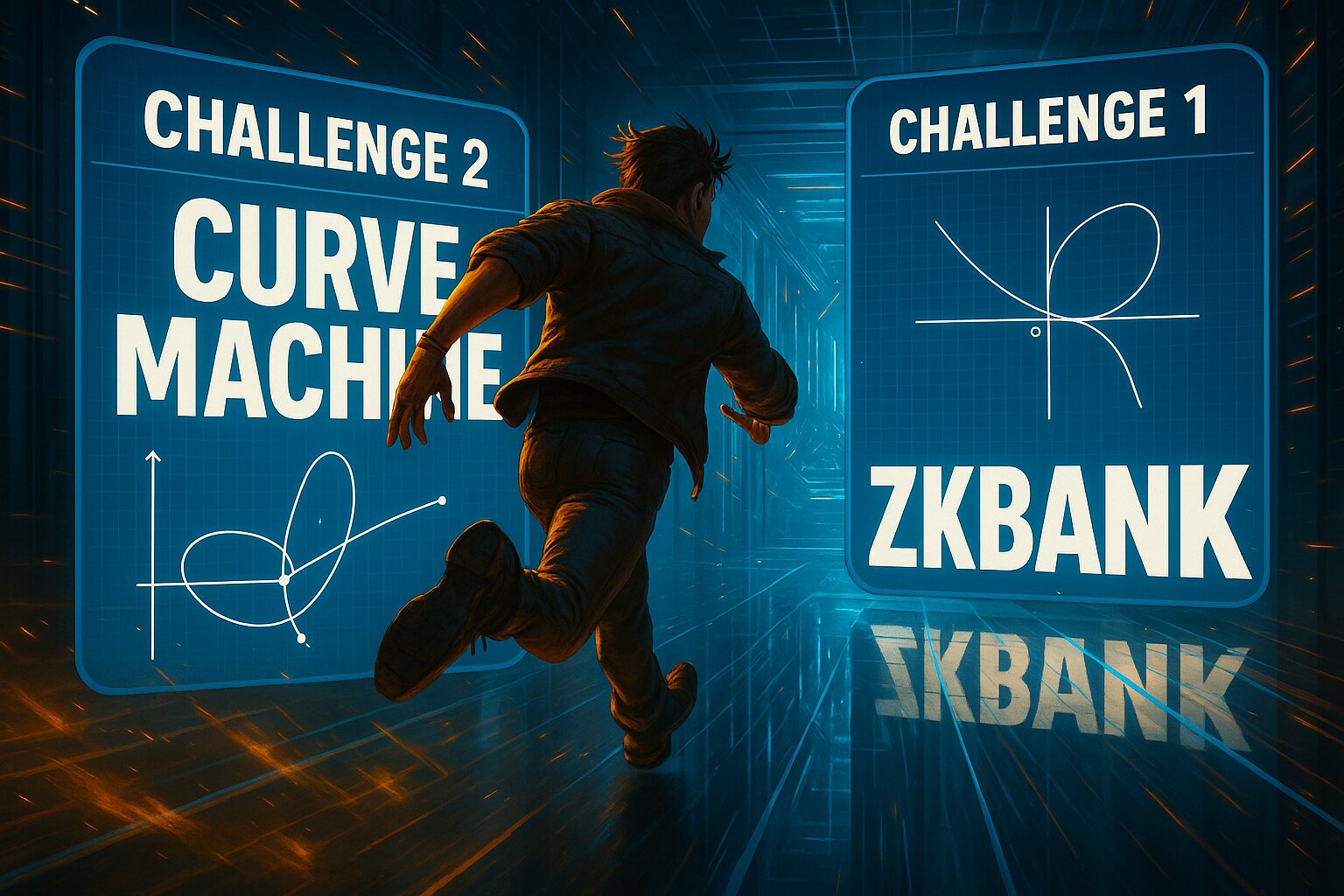
To get a chance at joining zkSecurity, candidates must now complete BOTH challenges:

  1. zkBank - Our original challenge that tests your ability to learn and apply knowledge across various areas of ZK. Check it out at https://blog.zksecurity.xyz/posts/zkbank/

  2. Curve Machine - Our new challenge that will push your skills even further in the world of zero-knowledge security.

Both challenges are designed to test different aspects of what makes a great ZK security researcher. If you think you have what it takes to solve them both, head over to our jobs page at https://zksecurity.xyz/jobs for all the details and get started!

Are you ready to prove yourself?

Keep reading
Latest

The Year Finding and Exploiting Bugs Became Cheap, and What to Do About It

The economics of security have changed. AI has made finding and exploiting bugs cheaper, including in cryptographic and zero-knowledge code, while validation and remediation remain slow. Here is our view of what happened, what comes next, and how teams should change the way they secure their stack to defend against AI-assisted attackers.

Stefanos Chaliasos · September 07, 2026

Variants of KZG: Part V, Multilinear Commitments with Mercury

In this final post of the series, we extend univariate KZG commitments to multilinear polynomials through Mercury. Building on Gemini, we fold half of the variables at once, use polynomial division to bind this large fold to the original commitment and reduce the remaining multilinear evaluations to a batched inner product check. We then walk through the end-to-end opening protocol. We conclude by examining its proof size, prover cost and verifier cost.

Varun Thakore · August 17, 2026

Variants of KZG: Part IV, Multilinear Commitments with Gemini

In this blog post, we extend univariate KZG commitments to multilinear polynomials through Gemini. We introduce recursive partial evaluations, derive the split-and-fold identity and express each fold as a univariate identity that can be checked using KZG openings. We then walk through the end-to-end opening protocol. We conclude by examining its proof size, prover cost, and verifier cost.

Varun Thakore · August 12, 2026
Recommended

zkBitcoin: Use Zero-Knowledge Applications (zkapps) on Bitcoin

We're excited to introduce zkBitcoin, a new tool that lets you create zero-knowledge applications on Bitcoin using a minimal layer 2 protocol. This innovation opens up a world of complex, privacy-focused apps by enhancing Bitcoin's scripting capabilities. We're currently on testnet, so you can jump in and explore the possibilities. Check out our whitepaper or watch some videos for a deeper dive. It's an exciting time for Bitcoin development, and we can't wait to see what you'll build!

David Wong · January 31, 2024

Introducing bugs.zksecurity.xyz a knowledge base for ZK bugs

We're thrilled to introduce our new site, [bugs.zksecurity.xyz](https://bugs.zksecurity.xyz/), a hub for exploring past vulnerabilities in ZK circuits. Dive into our growing catalog of documented bugs and learn how we've reproduced some with comprehensive scripts. Discover evaluations of prominent security tools like Circomspect and Picus, and see where they shine or stumble. We're calling on the community to join us in expanding this invaluable resource, whether by adding bugs, reproducing them, or improving our platform. Let's collaborate to elevate ZK security together!

Stefanos Chaliasos · February 17, 2025

Reproducing and Exploiting ZK Circuit Vulnerabilities

Check out our latest blog post where we dive into the world of Zero-Knowledge Proof (ZKP) vulnerabilities, sharing our insights from replicating known ZK circuit weaknesses. We’ve launched a GitHub repo with detailed scripts to help you understand, reproduce, and learn from these vulnerabilities. Discover how this hands-on approach aids in grasping attack vectors, testing fixes, and enriching educational resources. Whether you're a researcher or a developer, this post is packed with info to enhance your knowledge and skills in ZKP security. Plus, find out how you can contribute to expanding this invaluable resource!

Stefanos Chaliasos, Chenyang Yu · August 09, 2024
More to explore

wasmati: You should write your WebAssembly in TypeScript

If you're into WebAssembly (Wasm) and want to speed up your JavaScript, this blog post is for you! We talk about our journey with Wasm and how we created a TypeScript library called wasmati that lets you write Wasm at the instruction level. You'll get the inside scoop on how this can significantly improve performance, especially for cryptography work. Plus, we showcase a real-world example comparing Wasm and JS bigint performance, proving that Wasm can be over four times faster. Dive in to see how we've combined the flexibility of TypeScript with the power of Wasm for high-performance coding.

Gregor Mitscha-Baude · June 02, 2023

zkNews Is Now Open to Everyone

zkNews is now open to everyone. When we first launched, access was limited to a small beta group to keep things stable while we found our footing. That rate limit is gone. Anyone can now sign up, submit links, and join the discussion at news.zksecurity.xyz. Come help us build the home for zero-knowledge news.

ZK/SEC · June 06, 2026

Introducing clean, a formal verification DSL for ZK circuits in Lean4

We're diving into our new project called **clean**, aimed at creating an embedded DSL and formal verification framework for Zero Knowledge (ZK) circuits using Lean4. Imagine being able to not only define ZK circuits but also formally prove their correctness. Sounds like a game-changer, right? We'll walk you through our process of building a robust library of reusable, verified circuit gadgets, focusing on the importance of soundness and completeness. Plus, you'll get a peek at some cool examples like 8-bit addition and how we're tackling ZKVM design with techniques borrowed from Fibonacci sequences. It's exciting stuff, and if you're curious about how we're paving the way for bug-free ZK circuits, this is a read you won't want to miss!

Giorgio Dell'Immagine · March 27, 2025