ZK/SEC Research notes from zkSecurity
All posts
Proof is in the Pudding · Part 2 of 10

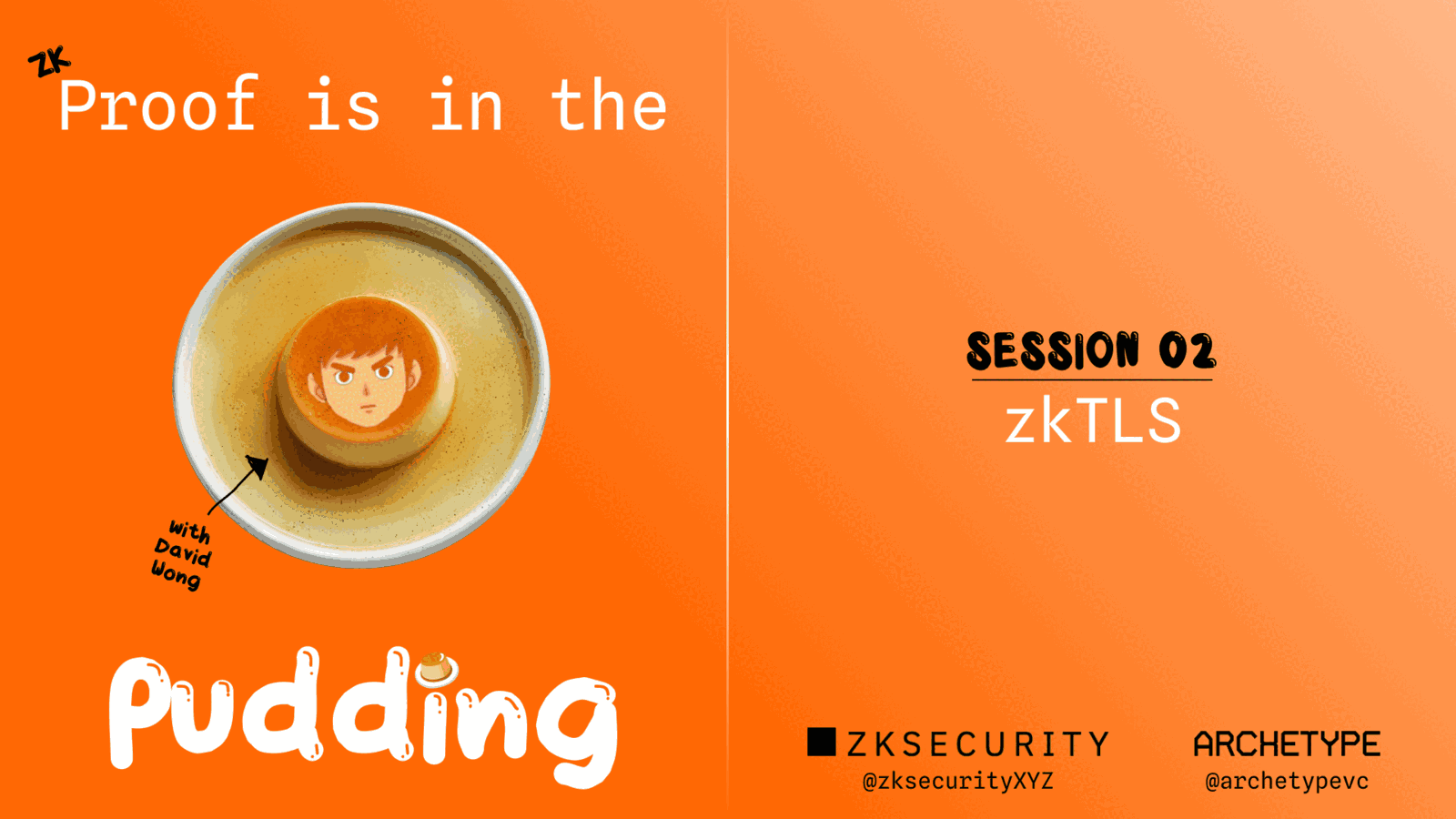
Archetype x zkSecurity (Whiteboard Session) - Proof is in the Pudding: zkTLS

Proof is in the Pudding: zkTLS

Proof is in the Pudding is a IRL series of whiteboard sessions hosted by Archetype and zkSecurity.

For Session 02, we cover zkTLS (also called zkOracles, HTTPz, or MPC-TLS). This includes public approaches like public oracles (chainlink), TEE approaches like TownCrier, TLS Notary and Deco style approaches that mix using MPC protocols or pure proxies.

recorded session of proof is in the pudding

Watch it on Archetype's channel!

Keep reading
Latest

The Year Finding and Exploiting Bugs Became Cheap, and What to Do About It

The economics of security have changed. AI has made finding and exploiting bugs cheaper, including in cryptographic and zero-knowledge code, while validation and remediation remain slow. Here is our view of what happened, what comes next, and how teams should change the way they secure their stack to defend against AI-assisted attackers.

Stefanos Chaliasos · September 07, 2026

Variants of KZG: Part V, Multilinear Commitments with Mercury

In this final post of the series, we extend univariate KZG commitments to multilinear polynomials through Mercury. Building on Gemini, we fold half of the variables at once, use polynomial division to bind this large fold to the original commitment and reduce the remaining multilinear evaluations to a batched inner product check. We then walk through the end-to-end opening protocol. We conclude by examining its proof size, prover cost and verifier cost.

Varun Thakore · August 17, 2026

Variants of KZG: Part IV, Multilinear Commitments with Gemini

In this blog post, we extend univariate KZG commitments to multilinear polynomials through Gemini. We introduce recursive partial evaluations, derive the split-and-fold identity and express each fold as a univariate identity that can be checked using KZG openings. We then walk through the end-to-end opening protocol. We conclude by examining its proof size, prover cost, and verifier cost.

Varun Thakore · August 12, 2026
Recommended

Archetype x zkSecurity - Proof is in the Pudding: Privacy in Payment Networks

In Session 08 of "Proof is in the Pudding," we explore how different networks have approached privacy over the years. From E-Cash and Monero to MobileCoin and Zether, we break down blind signatures, Pedersen commitments, stealth addresses, ring signatures, and more. This session provides a comprehensive tour of the techniques used to break linkability, hide addresses, and obscure transaction data in the name of privacy and safety.

ZK/SEC · January 16, 2026

Projects That Shaped Modern zkVMs, Part 1

Curious about how zero-knowledge virtual machines (zkVMs) make computing more secure without the hassle? We delve into the fascinating world of zkVMs, where you can program in high-level languages like Rust or C and let cryptography handle the complexity. We'll explore the evolution of these innovative systems through projects like Cairo and RISC Zero, while touching on the unique benefits and technical insights each brings. Plus, learn about groundbreaking techniques for optimizing zkVMs with projects like Jolt, and discover a range of other influential zkVM initiatives. Get ready for an enlightening journey into secure computation!

Marco Besier, David Wong · February 26, 2025

zkVM Security: What Could Go Wrong?

Ever wondered how zkVMs simplify the use of zero-knowledge proofs in coding? We dive into how they let developers focus more on application logic by abstracting complex cryptographic aspects, using familiar languages like Rust or C++. But hold on, it's not all smooth sailing. Despite these benefits, a single bug anywhere in the complex system of compilers, proof systems, or verification can lead to serious security issues. In the post, we break down the zkVM workflow, explore common vulnerabilities at each phase, and highlight the importance of understanding these layers to build more secure, zk-powered applications. Curious about how this all plays out? Let’s unravel it together!

Suneal Gong · November 21, 2024
More to explore

Common Circom Pitfalls and How to Dodge Them, Part 2

This post is the second part of our series on Circom pitfalls. While part 1 covered issues with assertions, hints, and aliasing, this one explores unsafe component usage and the subtle fact that Circom’s comparison operators work over signed integers.

Marco Besier · November 10, 2025

Faster Sumchecks: Part I

In this blog post, we explore how to optimize the sumcheck protocol, particularly when working with values in a small field and randomness from a large field, as often needed in zkVMs. We introduce various algorithms aimed at reducing expensive operations, focusing on minimizing large multiplications. Starting from using simple evaluation tables to more sophisticated techniques like precomputing accumulators and leveraging Lagrange interpolation, we demonstrate how to efficiently organize computations to speed up proving times. Readers will gain insights into handling arithmetic operations within the sumcheck protocol and learn about optimizing specific cases in zero-knowledge proofs.

Jason Park · November 21, 2025

Do in secret. Assert in public. Don't under-constrain your prover's witness computation in ZK programs

Curious about diving into zero-knowledge (ZK) application development? Our blog post is here to guide you through the common security pitfalls and mindset shifts essential for tackling ZK programming. We reflect on our journey from the early days of Mina Protocol to the dynamic space today, filled with tools like SnarkyJS and newer approaches to split the prover and verifier roles effectively. Discover the errors to avoid, like under-constraining data and letting divisors slip through unchecked, and learn how a solid review and audit process can save your ZK applications from disastrous security issues. Dive in to get the insights you need to navigate the ZK landscape confidently!

Brandon Kase · June 01, 2023