ZK/SEC Research notes from zkSecurity
All posts
Proof is in the Pudding · Part 2 of 11

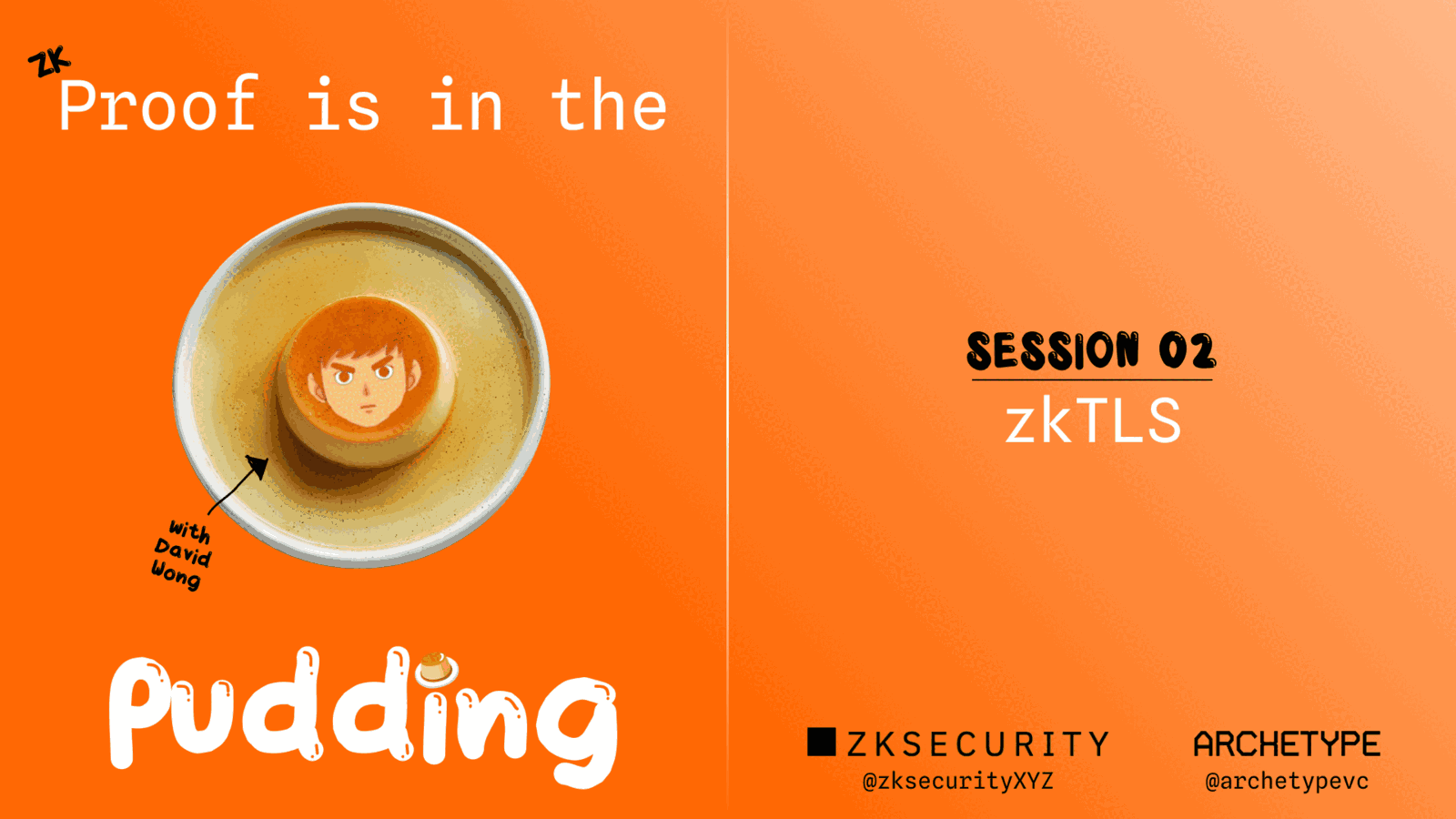
Archetype x zkSecurity (Whiteboard Session) - Proof is in the Pudding: zkTLS

Proof is in the Pudding: zkTLS

Proof is in the Pudding is a IRL series of whiteboard sessions hosted by Archetype and zkSecurity.

For Session 02, we cover zkTLS (also called zkOracles, HTTPz, or MPC-TLS). This includes public approaches like public oracles (chainlink), TEE approaches like TownCrier, TLS Notary and Deco style approaches that mix using MPC protocols or pure proxies.

You can also watch it on Archetype's channel.

Keep reading
Recommended

Archetype x zkSecurity - Proof is in the Pudding: Privacy in Payment Networks

In Session 08 of "Proof is in the Pudding," we explore how different networks have approached privacy over the years. From E-Cash and Monero to MobileCoin and Zether, we break down blind signatures, Pedersen commitments, stealth addresses, ring signatures, and more. This session provides a comprehensive tour of the techniques used to break linkability, hide addresses, and obscure transaction data in the name of privacy and safety.

ZK/SEC · January 16, 2026

Projects That Shaped Modern zkVMs, Part 1

Curious about how zero-knowledge virtual machines (zkVMs) make computing more secure without the hassle? We delve into the fascinating world of zkVMs, where you can program in high-level languages like Rust or C and let cryptography handle the complexity. We'll explore the evolution of these innovative systems through projects like Cairo and RISC Zero, while touching on the unique benefits and technical insights each brings. Plus, learn about groundbreaking techniques for optimizing zkVMs with projects like Jolt, and discover a range of other influential zkVM initiatives. Get ready for an enlightening journey into secure computation!

Marco Besier, David Wong · February 26, 2025

zkVM Security: What Could Go Wrong?

Ever wondered how zkVMs simplify the use of zero-knowledge proofs in coding? We dive into how they let developers focus more on application logic by abstracting complex cryptographic aspects, using familiar languages like Rust or C++. But hold on, it's not all smooth sailing. Despite these benefits, a single bug anywhere in the complex system of compilers, proof systems, or verification can lead to serious security issues. In the post, we break down the zkVM workflow, explore common vulnerabilities at each phase, and highlight the importance of understanding these layers to build more secure, zk-powered applications. Curious about how this all plays out? Let’s unravel it together!

Suneal Gong · November 21, 2024
More to explore

Listen to us on the latest episode of zeroknowledge.fm

Join our cofounder David Wong on the latest zk podcast as he dives into his compelling journey through cryptography, from his early days as a security consultant to his pivotal roles in major projects like Facebook's crypto initiatives and Mina. Get an insider's view on how we approach auditing in a Zero Knowledge context, the common pitfalls in ZK code, and how these insights shape our work. It's an engaging and informative chat for anyone fascinated by the world of cryptography and ZK technology!

ZK/SEC · August 30, 2023

Powers-of-Funbenius

A one-character repeated-squaring bug in Inferno's Limbo implementation turns the intended random polynomial check into a linearized Frobenius check over a binary extension field. This post walks through why the usual Schwartz-Zippel argument disappears, how periodicity of the Frobenius map makes collisions immediate after 64 multiplication gates, and how even smaller circuits can cheat with noticeably higher probability.

Mathias Hall-Andersen · May 05, 2026

ZNARKs: SNARKs for The Integers

Hey there! Interested in learning about SNARKs that work beyond finite fields? We’ve been diving into $\mathbb{Z}$NARKs, which are SNARKs tailored for computations involving integers. Our latest post unpacks this intriguing area, showing how we can construct efficient proof systems for integer-based computations. You'll discover nifty tricks like range checks without bit decomposition and mixed field emulation, plus how these techniques can simplify RSA computations. Intrigued by the idea of using randomness for more reliable proofs or exploring an intellectual curiosity like $\mathbb{Q}$-circuits? This post covers it all, including a peek into the future of polynomial commitments. Dive in and explore with us!

Mathias Hall-Andersen · November 11, 2024