ZK/SEC Research notes from zkSecurity
All posts
Proof is in the Pudding · Part 1 of 10

Archetype x zkSecurity (Whiteboard Session) - Proof is in the Pudding: Arithmetization

Proof is in the Pudding: Arithmetization

Proof is in the Pudding is a IRL series of whiteboard sessions hosted by Archetype and zkSecurity.

For Session 01, David from zkSecurity started at the ground floor with arithmetization. Arithmetization involves the process of converting logical statements into algebraic form, which are then used to create arithmetic circuits, a key building block in the construction of a ZK proof.
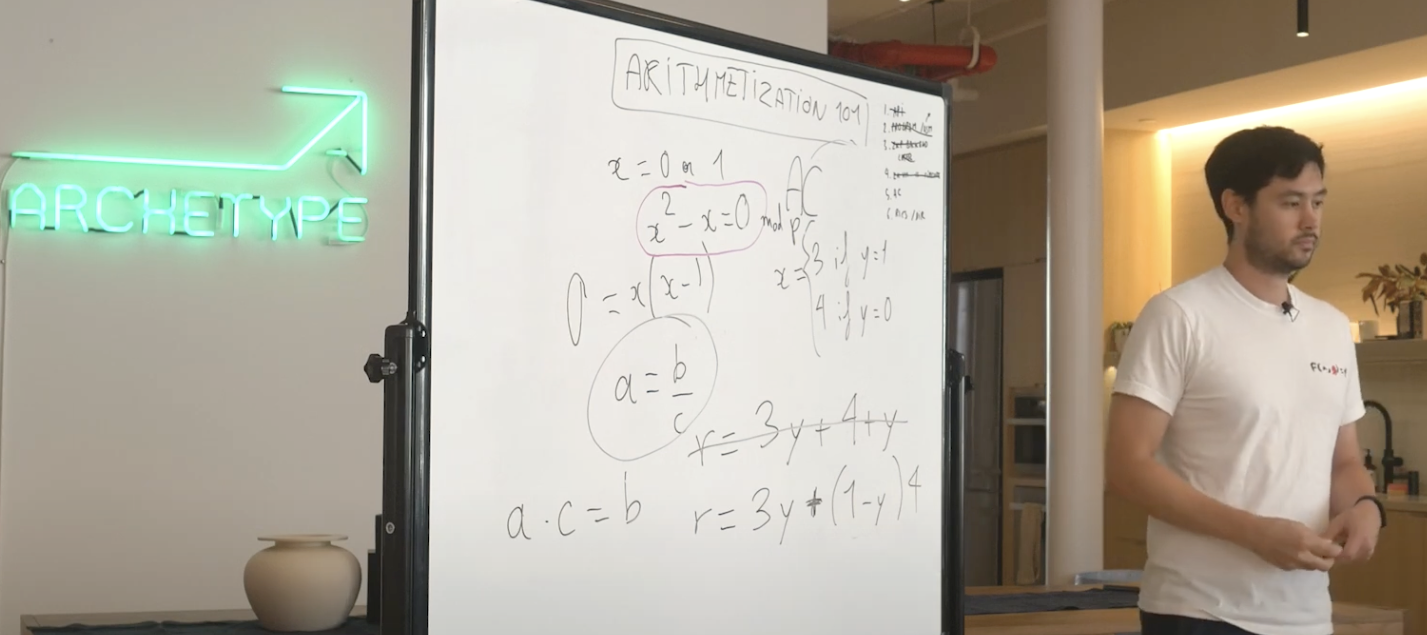
recorded session of proof is in the pudding

Watch it on Archetype's channel!

Note that this is an unedited recording of the session.

Keep reading
Recommended

KZG vs IPA vs FRI: Picking the Right Polynomial Commitment Scheme

A practical guide to the trade-offs between KZG, IPA/Halo, and FRI, the three major polynomial commitment scheme families powering modern zero-knowledge proof systems. We compare proof sizes, verification costs, trust assumptions, benchmarks, and on-chain gas costs.

ZK/SEC, University of Padua · March 23, 2026

Groth16, Intuitively

Groth16 is still the gold standard for succinct SNARKs: 128-byte proofs, constant-size verification, and a decade of real-world deployment. But despite its ubiquity, almost nobody explains *why* it works the way it does. In this post, we build Groth16 from the ground up, starting from R1CS and QAPs, then layer in pairings, trusted setup parameters, and the separator tricks (α, β, γ, δ) that make the scheme sound. By the end, you should have an intuitive grasp of every term in the final verifier equation.

David Wong · May 01, 2026

BitVM: Unlocking Arbitrary Computation on Bitcoin Through Circuit Abstractions

We're diving into the world of Bitcoin's UTXO model and how recent advancements like BitVM can overcome its limitations, allowing for more complex computations without changing Bitcoin's core. This blog post explores cutting-edge techniques like covenants, statefulness, and circuit models, showing how they enable intricate logic on Bitcoin. We'll break down how these innovations make trustless cross-chain transactions possible, and highlight the potential of optimistic protocols to optimize the on-chain footprint. If you're curious about the future of Bitcoin's capabilities, this is the deep dive you need!

Katat Choi · March 03, 2025
More to explore

zk.golf: Fearless and Collaborative Optimization of Circuits

zk.golf is a platform where people can compete on creating the most efficient zk circuits for specific problems. It is enabled by what we call "fearless optimization", which is achieved by combining formal verification and frontier AI models. By the end, you will be convinced that nobody should look at constraints ever again in their life.

Giorgio Dell'Immagine, Mathias Hall-Andersen · July 02, 2026

AI meets Cryptography 1: What AI Found in Cloudflare's CIRCL

We pointed our AI audit pipeline at Cloudflare's CIRCL experimental cryptography library and confirmed seven real bugs, from a critical float64 precision loss in threshold RSA to a complete access-control break in attribute-based encryption. All seven are now fixed upstream. This is the first post in a series on bugs our agents found across open source cryptography.

Stefanos Chaliasos, Hao Pham, False Witness team · July 07, 2026

A challenge on the Jolt zkVM

Last weekend, we had a blast crafting challenges for a CTF event at the MOCA Italian hacker camp. One cryptography challenge, "2+2=5," involved the Jolt zkVM and a RISC-V program. In this post, we share the ins and outs of the challenge, the clever use of a modified Jolt library, and how we managed to prove an invalid execution without triggering verification alarms. Get ready to dive into the world of Jolt and pick up some nifty insights on exploiting cryptographic systems like a true hacker.

Giorgio Dell'Immagine · September 24, 2024